Information modeling and Companion Specifications
By means of object-oriented mechanisms, even complicated, multi-layered structures and their behavior can be clearly mapped and systematically extended.
A simple example of the definition and application of an information model that uses some essential descriptive elements is that of an intelligent pump. This not only generates a volume flow, but also measures inline the dynamic viscosity of the fluid in centipoise (cP). In addition, a maintenance index is used to indicate the need for maintenance. If the viscosity exceeds or falls below a certain limit, an alarm is automatically signaled.

The information models shown in the figure show the derivation of the own special pump type from the general OPC UA type "DeviceType" and the use, i.e. the location, of the pumps within the address space of the OPC UA server of an exemplary machine or plant.
OPC UA information models basically consist of nodes and references. References represent the relationship between two nodes that describe something specific. A distinction is made between an instance model and a type model, whereby the object-oriented mechanisms such as inheritance can be used. The following constructs are available for modeling.
Node (NodeClass)
-
Object & ObjectType
-
Variable & VariableType
-
MethodType
References (ReferenceType)
-
HierarchicalReferences, e.g.
-
HasComponent
-
HasProperty
-
HasSubType
-
-
NonHierarchicalReferences, e.g.
-
HasTypeDefinition
-
The nodes and references required to create the pump's information model in the very simple example above suggest, that it is neither easy nor efficient to create information models from scratch.
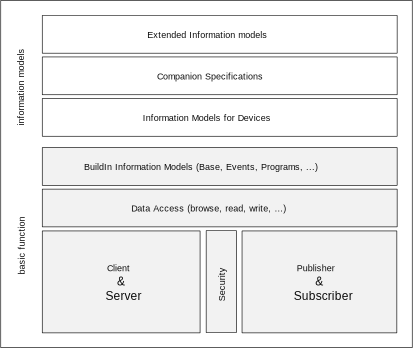
The following figure shows the logical layers of OPC UA modeling, which -favor a strong reuse of information models. The information models themselves can be built up in different ways. Either they are modeled from scratch, or they are built on top of each other.
The basis of many information models is the Information Model for Devices, which is described in Part100 of the OPC UA specification. This information model is used by many Companion Specifications that standardize information models for a specific domain. Examples are the PLCopen Companion Standard for general IEC applications or the Euromap for injection molding machines.
Beyond the standard, the resulting information model in the OPC UA server can still be enriched with manufacturer-specific models.