Determining the parameters lrEigenFreq and lrAmpRatio
Step 1: Stimulation of the mechanics
In order to determine both parameters, the construction must be brought to oscillation with a switched-off compensation. There are two possibilities:
- Travel the drive of the construction with the usual velocity and then brake the drive with
- a deceleration as high as possible and
- a jerk as high as possible
- Travel the drive with a usual motion with increased jerk values.
Step 2: Generating sensor information
If the drive is then at standstill, an external measuring device (e.g. acceleration sensor, external position sensors or extension measurement) can be used to measure the oscillation. The signal should be zero-mean to the greatest possible extent, i.e. the occurring measured values should be distributed evenly around zero.
For the case that no external measuring device is available, the current torque of the axis or the following error can be frequently used as an alternative.

 Tip!
Especially for displaying the chronological sequences use the trace function of the »PLC Designer« engineering tool.
Step 3: Evaluating the measured signals
|
Determining the parameters lrEigenFreq and lrAmpRatio |
|
|---|---|
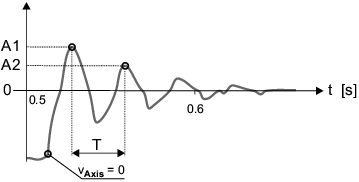
A1 = amplitude of the first oscillation A2 = amplitude of the second oscillation T = time for one oscillation (period)
Note: The above representation is a detail of the "Curve with switched-off oscillation compensation"
|
|
|
Equation |
Info |

|
Determine the lrEigenFreq parameter by measuring the time between a certain number of oscillations. |
|
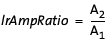
Determine the lrAmpRatio parameter by measuring the amplitudes of two successive oscillations and putting them into relation. |
 Example of the effectiveness of the FB
section