Product description
Product identification
This documentation is applicable to the following components with their identification:
Name of product and product ID
|
Name of product |
Product ID |
|---|---|
|
i9x0 servo inverters |
I95Bxxxxxxxxx0xxxx |
|
i9x0 servo inverters, DC link |
I95Cxxxxxxxxx0xxxx |
|
i9x0 servo inverters, Extended customer specific |
I95BxxxxxxxxxWxxxx |
|
i9x0 servo inverters, DC link, Extended customer specific |
I95CxxxxxxxxxWxxxx |
Location in the network
These components are located in the automation pyramid at the control level or the field level. Furthermore, they are located in the security zone 'CAP-Machine' or security zone ‘CAP Field’ (Zones and conduits).
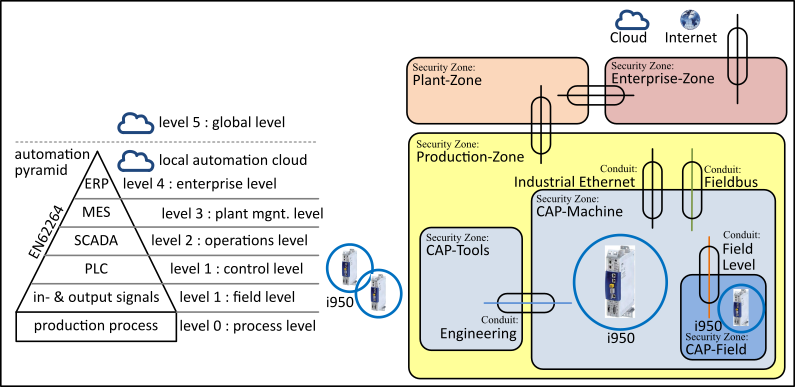
Location in the Network
The level or zone in which the i9x0 servo inverters is placed depends on the area of use. A distinction can be made between three modes, which the customer can choose with the device parameter 0x4000.
-
The parameter 0x4000 is set to CiA402, e.g. ‘CIA 402 [0]’. The i9x0 is then operated as a follower drive under motion control and thus falls into the field level and the security zone CAP-Field.
-
The parameter 0x4000 is set to a prepared TA (technology application), e.g. ‘TA Table Positioning [20]’. The i9x0 is then operated as a drive under logic control and thus falls into the field level and the security zone CAP-Field.
-
The parameter 0x4000 is set to a free programmable device, e.g. ‘TA User [10000]’. The i9x0 is then operated as a really small Controller and thus falls into the control level and the security zone CAP-Machine.
The components addressed here have four relevant interfaces:
-
Conduit: Industrial Ethernet
Between the i9x0 and the 'Conduit: Industrial Ethernet' is the IoT gateway. Its task is to enable zone protection. If there is no IoT gateway in the system, the operator must ensure appropriate security at the zone border. This interface is not an open interface for direct connection to the Internet. The operator must interpose appropriate security measures to maintain the security zone. -
Conduit: Fieldbus
The fieldbus requires special consideration within cyber security. The fieldbuses are standardized and, in most cases, have no integrated security functions. Thus, this interface must be considered with a classification SL-0 in the risk assessment of the operator. -
Conduit: Engineering
This conduit has the property that it does not exist continuously, but only during commissioning or maintenance of the machine. Here, the system design must take into account in the risk assessment that the accesses are authorized and the employees have been instructed on the components and the machine cyber security concept. Furthermore, it must be ensured that the computer systems on which the necessary tools are installed comply with the current cyber security requirements and correspond to the state of cyber security. -
Conduit: Field level
This conduit connects the i9x0 to other devices via EtherCAT. These other devices are for example i9x0 servo inverters of the same type or I/O systems for extending the onboard IOs.
Intended purpose:
The intended use of these components is described in the application as directed and can be found in the operating instructions for the respective component. In the following, some specifics regarding cyber security are discussed.
-
These components mentioned here are professional equipment and may only be commissioned and decommissioned by specialists.
-
These components also require maintenance during their life cycle, which must be carried out by the operator.
-
Modifications to the firmware or hardware of these components are not permitted.
-
If these components are taken out of operation or disposed of, the instructions here in the documentation must be observed.
-
Do not install any optional unused modules (minimize attack surface).
Intended environment
The intended environment for these components is described in the application as directed and can be found in the operating instructions for the respective component. In the following, some specifics regarding cyber security are discussed.
-
These components must be mechanically protected against unauthorized use. This can be achieved, for example, via physical access control systems or lockable control cabinets. In this case, access may only be granted to authorized persons and the number of accesses should also be restricted.
-
In particular, the removal of the SD Card may only be carried out by users authorized by the operator.
-
The components are not operated directly on the open Internet, but must also be ope rated by the operator via protection systems such as firewall, IDS, IPS, … .
-
Deactivate all unused interfaces and/or protocols, both for the components mentioned here and for all components that are connected to the network.
-
The more security-critical an application is, the more systems should be separated. Only combine tasks on one component if they are in the same risk classification.
-
Wherever possible, use a Defense-in-Depth Concept in the environment of this component.
-
Use appropriate authentication mechanisms. This applies, for example, passwords that have the necessary complexity and an appropriate life cycle. The current state of the art must be taken into account here.
-
Handle secrets, such as passwords, appropriately. The focus here is on handling of secrets on the noted components, but also on the data stored in the environment of these components.
-
Validate all input options for validity. Pay attention to all human user interfaces as well as the machine software interfaces.
-
Keep the installed firmware version up to date and install updates.
-
Evaluate the environment, the technical task to be performed and the existing component security in a security-critical consideration and assess whether additional protective measures are necessary for your application.
Security key indicators
Security key indicator (in accordance with IEC 62443-4-2):
-
These components are considered embedded devices (EDR).
-
These components have a security level of SL-C 0.
-
These components have an SL-vector from SL-C(i9x0)={ IAC=0; UC=0; SI=0; DC=0; RDF=0; TRE=0; RA=0 }.