Defense in Depth concept
Due to the increasing networking of horizontal and vertical data streams, the need for cyber security in automation systems is increasing. IEC 62443 requires a protection concept "Defense in Depth". This requires multi-layer protection in automation at both system and component level. The following describes the Defense in Depth concept at the system level. The schematic structure Minimization of in the following picture.
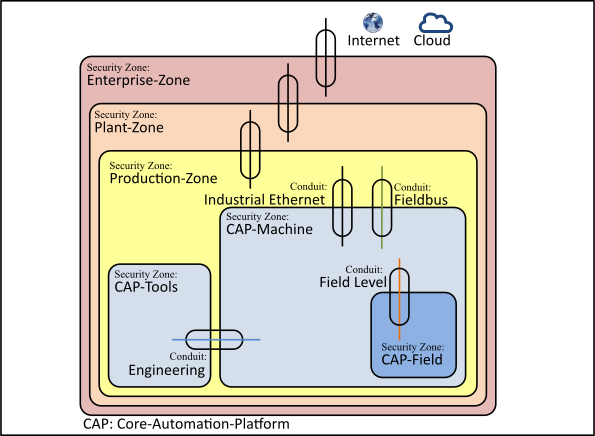
Defense in Depth Concept
Here, the protection mechanisms for the operator of a plant fall on the enterprise, plant and production zones. A consideration according to IEC 62443-3-x is recommended.
The following properties are assumed and must be ensured by the operator:
-
Minimization of the physical access to the machine, e.g. locking the cabinets.
-
Firewall Protection to minimize the Attack Surface.
-
Virus Protection to scan all data in motion and at rest.
-
Risk appropriate authentication methods.
-
Organizational measures for protection, when handling with removable data carriers.
A security zone called "CAP Machine" is defined within the production zone. The components in this zone are permanently active and must have the same level of protection.
Additionally, a security zone called "CAP Tools" contains all commissioning and maintenance tools. These tools are not permanently active, but only when necessary. Within the "CAP Machine" security zone, there is a subordinate "CAP Field" security zone. The components in this zone are permanently active, but must be protected by organizational measures.
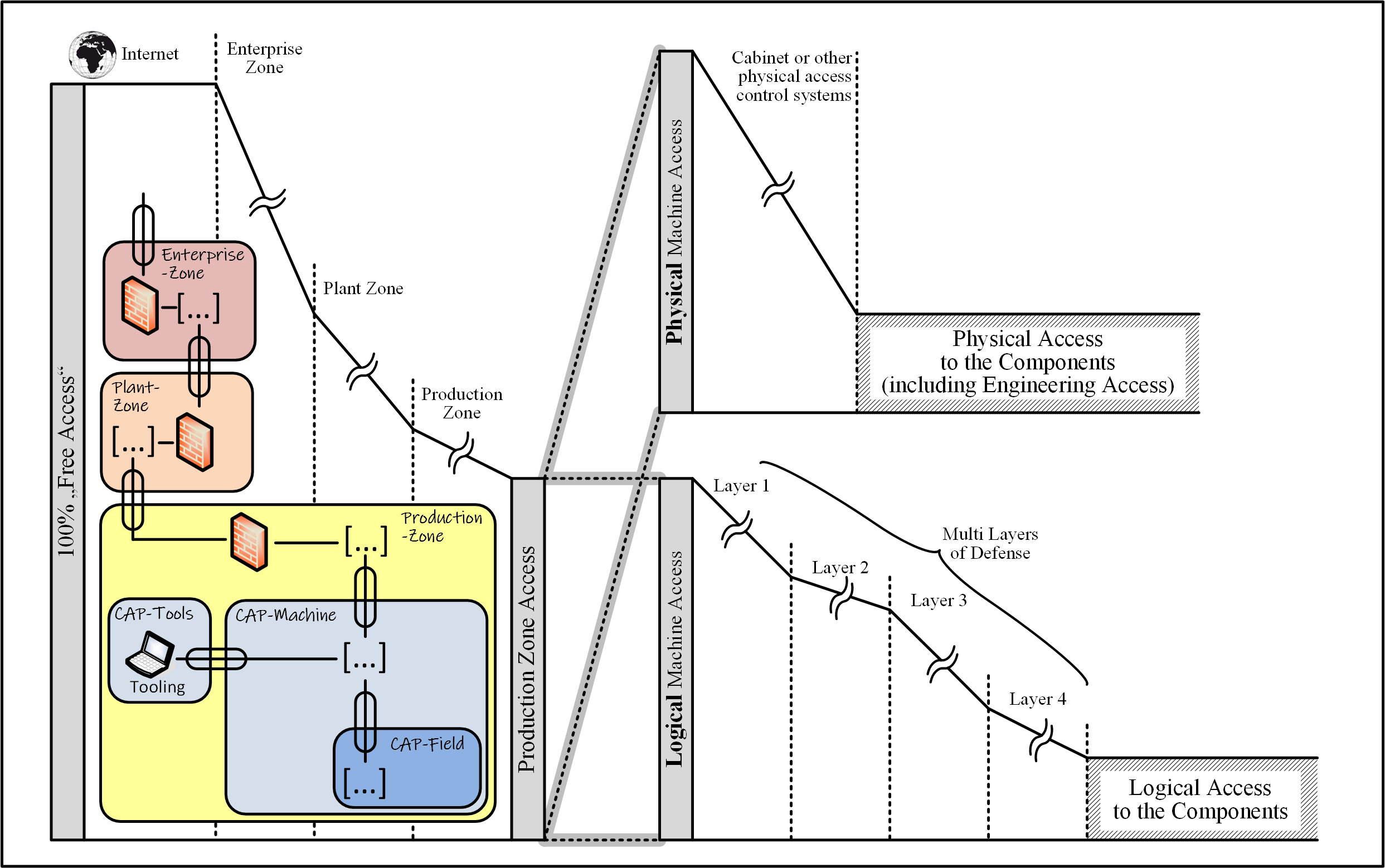
Multi Layers of Defense
Some examples of defenses of depth are described below. They are not intended to be exhaustive, but merely examples that need to be defined and detailed through a risk assessment in the operation.
Multi Layers of Defense in the Enterprise-, Plant- and Production-Zone (in responsibility of the Operator):
-
Administrative Controls: Policies & Procedures
e.g. Cyber Security Guidelines and Implementation of Organizational Activities -
Administrative Controls: User Training & Awareness
e.g. Education of cyber security best practices -
Administrative Controls: Access Control Policies
e.g. Definition of Rights, Groups and Users -
Administrative Controls: Monitoring or/and Auditing
e.g. Review of Policies & Procedures and Monitoring of Auditable Events -
Administrative Controls: Implement of Incident Response Team
e.g. Receiving, reviewing , assessing and addressing security-related issues and/or incidents. -
Physical Controls: Facility Access
e.g. Restrict access to Enterprise-, Plant- and Production Zone. -
Physical Controls: Visitor Access
e.g. Enforcing Visitor Protection -
Technical Controls: Firewalls
e.g. Minimize system surface via blocking networks, devices, ports -
Technical Controls: Network Monitoring
e.g. Intrusion Detection Systems and Intrusion Prevention Systems -
Technical Controls: Antivirus Detection
e.g. Protection of network virus detection and virus detection running on the host-systems -
Technical Controls: Encryptions
e.g. Use only encrypted protocols and encrypt relevant data
Multi Layers of Defense for Physical Machine Access:
-
Physical Controls: Cabinet Access or Physical Barriers
e.g. Restrict access to Cabinets
Multi Layers of Defense for Logical Machine Access:
-
Administrative Controls: Policies & Procedures
e.g. Implement measures of the Components (refer to Cyber Security Technical Documentation). -
Technical Controls: Firewalls
e.g. Restrict component surface via blocking ports, protocols (refer to Cyber Security Technical Documentation) -
Technical Controls: Encryption
e.g. Use encryption for protocols and relevant data (refer to Cyber Security Technical Documentation) -
Technical Controls: Access Contol
e.g. Configuration of Rights, Groups and Users of the components (refer to Cyber Security Technical Documentation) -
Technical Controls: Backup and Restore
e.g. After first implementation generate a Backup and verify the Backup via Restore (refer to Cyber Security Technical Documentation)