Point-to-point movements and Cartesian path movements
If a movement command is issued for a machine using a function block, this results in the TCP ("Tool Centre Point") being moved to the requested position (position + orientation). The type of function block used determines the path along which the commanded position is reached. (The coordinate system in which the requested position was specified has no influence on the path).
There are basically two types of movement:
- Point-to-point movements (PTP: Point To Point movements)
- Cartesian path movements (CP: - Cartesian Path movements)
Point-to-point movements (PTP)
Point-to-point movements are mainly used to reach a commanded position as quickly as possible.
- The path and path speed of the TCP are not important for this type of movement. They result from the positioning sequence of the individual axes and the kinematic transformation of the machine.
- Each ACS axis is moved the shortest distance from the start position to the target position, as at least one axis can always fully utilise its dynamics. The boundary condition here is that all axes should reach the commanded position at the same time (synchronised).
- The path of the TCP in cartesian space depends highly on the kinematic of the axes group and the individual default values of the ACS axes.
- The path of the TCP in cartesian space is independend of the axes group override.
Relevant function blocks for point-to-point movements:
Cartesian path movements (CP)
With a Cartesian path movement, the TCP is moved along a defined path in Cartesian space.
- The path and path speed of the TCP are of decisive importance for this type of movement (example: milling a workpiece).
- A path is defined by straight lines, circular arcs and blending curves.
- The maximum path speed, maximum path acceleration and the path jerk of the TCP can be set via the input parameters of the FBs.
- The positioning sequence for each axis results from the desired path and the inverse kinematic transformation (backward transformation).
Relevant function blocks for Cartesian path movements:
The following illustration shows the differences between the various types of movement using a theoretical machine. Typical positions of a machine axis involved in positioning are shown on the right.
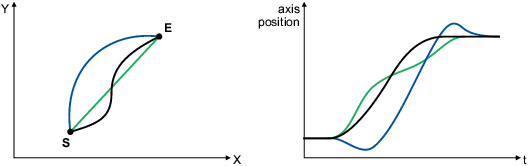
black: Point-to-point movement (MC_MoveDirect...) green : Linear interpolation (MC_MoveLinear...) blue : Circular interpolation (MC_MoveCircular...) |
 [16-6] Different types of movement