L_TB1P_FrictionCompensation
This FB includes the "Friction identification" and "Friction compensation" functions.
- By means of the "Friction identification" function ( xIdent = TRUE), the friction characteristic can be automatically identified.
- With the "Friction compensation" function ( xEnableFrictionCurve = TRUE), a speed-dependent compensation of the friction torque can be executed on the basis of a linear characteristic or friction characteristic that has been automatically determined before.
|
|
|
|
L_TB1P_FrictionCompensation |
|
|
|
|
|---|---|---|---|---|---|---|---|
|
BOOL |
- |
|
xIdent |
xBusy |
|
- |
BOOL |
|
BOOL |
- |
|
xFollowerActive |
xDone |
|
- |
BOOL |
|
LREAL |
- |
|
lrActReelSpeedIn |
xError |
|
- |
BOOL |
|
LREAL |
- |
|
lrActTorqueIn |
eErrorID |
|
- |
L_IE1P_Error |
|
DWORD |
- |
|
dwSelectCurve |
xStop |
|
- |
BOOL |
|
BOOL |
- |
|
xEnableFrictionCurve |
xEnableFollower |
|
- |
BOOL |
|
LREAL |
- |
|
lrSetReelSpeed |
lrSetReelSpeedOut |
|
- |
LREAL |
|
LREAL |
- |
|
lrFrictionAdapt |
lrSetFrictionTorqueOut |
|
- |
LREAL |
|
BOOL |
- |
|
xInvertOutput |
|
|
|
|
|
LREAL |
- |
|
lrMaxSpeedIdent |
|
|
|
|
|
LREAL |
- |
|
lrAccDecIdent |
|
|
|
|
|
LREAL |
- |
|
lrFilterTimeSpeed |
|
|
|
|
|
LREAL |
- |
|
lrFilterTimeTorque |
|
|
|
|
|
LREAL |
- |
|
lrFilterTimeReelSpeed |
|
|
|
|
|
LREAL |
- |
|
lrLinearCompStart |
|
|
|
|
|
LREAL |
- |
|
lrLinearCompEnd |
|
|
|
|
|
ARRAY [1...66] OF LREAL |
- |
|
alrFrictionCurve1 |
|
|
|
|
|
ARRAY [1...66] OF LREAL |
- |
|
alrFrictionCurve2 |
|
|
|
|
|
ARRAY [1...66] OF LREAL |
- |
|
alrFrictionCurve3 |
|
|
|
|
|
ARRAY [1...66] OF LREAL |
- |
|
alrFrictionCurve4 |
|
|
|
|
|
|
|
|
|
|
|
|
|
Inputs and outputs
|
Name Data type |
Information/possible settings |
|
|---|---|---|
|
alrFrictionCurve[1...4] ARRAY [1...66] OF LREAL |
Friction characteristics 1 ... 4 |
|
Inputs
|
Name Data type |
Information/possible settings |
|
|---|---|---|
|
xIdent BOOL |
TRUE |
Friction identification: Start identification of the friction characteristic. |
|
xFollowerActive BOOL |
Interface for feedback that setpoint generation has been enabled (e.g. SMC_FollowVelocity.bBusy) |
|
|
lrActReelSpeedIn LREAL |
Current speed of the motor shaft (actual speed value)
|
|
|
lrActTorqueIn LREAL |
Current torque (actual torque value)
|
|
|
dwSelectCurve DWORD |
Friction identification ( xIdent = True) Selection of the memory area in which the friction values identified are stored.
|
|
|
Friction compensation ( xEnableFrictionCurve = TRUE, xIdent = FALSE) Selection of the characteristic for friction compensation.
|
||
|
xEnableFrictionCurve BOOL |
Activate friction compensation. |
|
|
TRUE |
Friction compensation is activated. |
|
|
FALSE |
The friction torque is reset to '0'. |
|
|
lrSetReelSpeed LREAL |
Speed setpoint for the friction characteristic
|
|
|
lrFrictionAdapt LREAL |
Value for the proportional evaluation of the friction characteristic
|
|
|
xInvertOutput BOOL |
TRUE |
The lrSetFrictionTorqueOut output signal is shown in an inverted fashion. |
|
lrMaxSpeedIdent LREAL |
Maximum speed for friction identification
|
|
|
lrAccDecIdent LREAL |
Acceleration for friction identification
|
|
|
lrFilterTimeSpeed LREAL |
Filter time constant for the actual speed value for friction identification
|
|
|
lrFilterTimeTorque LREAL |
Filter time constant for the actual torque value for friction identification
|
|
|
lrFilterTimeReelSpeed LREAL |
Filter time constant for the speed setpoint for friction compensation
|
|
|
lrLinearCompStart LREAL |
Initial friction torque for friction compensation |
|
|
lrLinearCompEnd LREAL |
End friction torque for friction compensation |
|
|
lrLinearCompEndReelSpeed LREAL |
Speed at end friction torque for friction compensation |
|
Outputs
|
Name Data type |
Value/meaning |
|
|---|---|---|
|
xBusy BOOL |
TRUE |
The "Friction identification" or "Friction compensation" function is active. |
|
xDone BOOL |
TRUE |
The "Friction identification" or "Friction compensation" function has been completed successfully. |
|
xError BOOL |
TRUE |
An error has occurred. For details see eErrorID . |
|
eErrorID L_IE1P_Error |
If xError = TRUE: Error number for the error that has occurred.
|
|
|
xStop BOOL |
xStop is set to TRUE if the friction identification process is aborted and can be used to control an external STOP function. |
|
|
xEnableFollower BOOL |
xEnableFollower is set to TRUE for activating a setpoint interface (e.g. SMC_FollowVelocity). |
|
|
lrSetReelSpeedOut LREAL |
Speed setpoint for friction identification
|
|
|
lrSetFrictionTorqueOut LREAL |
Current friction torque
|
|
Identifying the friction characteristic automatically
How to proceed:
-
Select the memory location for the characteristic.
Define the memory location (1 ... 4) in which the characteristic is to be saved via the dwSelectCurve input after the identification process has been carried out successfully.
-
Start identification process.
Set the xIdent input to TRUE.
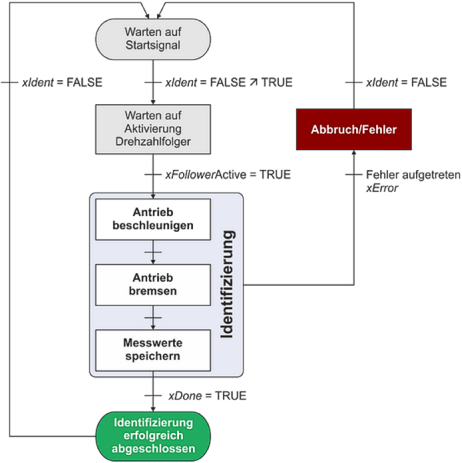
Friction identification process
- The basic function "Speed follower" is activated.
- With the acceleration set in lrAccDecIdent , the drive is accelerated to the maximum speed set in lrMaxSpeedIdent .
- When the drive has reached the maximum speed, it is braked to a standstill again with the acceleration set in lrAccDecIdent .
- The friction characteristic is saved in the memory area selected via the input dwSelectCurve .
- After a successful identification process, ...
- the xBusy output is set to FALSE;
- the xDone output is set to TRUE.
The identification is executed according to the following state machine:
|
State machine for the friction identification
Aborting the friction identification process
If the xIdent input is reset to FALSE, the active identification process is cancelled immediately. Resetting the xFollowerActive input to FALSE also results in the immediate abort of the process.
- The xBusy output is reset to FALSE.
- The xStop output is set for one cycle and can be used to control an external Stop function.
- The cause of abort is shown via the eErrorID output.
Smoothing the actual value signals
If incremental encoders are used, it may be required to filter the actual speed value signal.
The time constant for the filter can be set via the lrFilterTimeSpeed input. A setting of '10 ms' is sufficient in most cases.
Filtering the actual torque signal can be also helpful for smoothing the friction characteristic. The time constant for this filter can be set via the lrFilterTimeTorque input.
Activating the friction compensation
Friction compensation is active if the xIdent input is set to FALSE and the xEnableFrictionCurve input is set to TRUE.
The current speed is preselected via the lrSetReelSpeed input.
If the actual speed value exceeds the maximum value defined in the characteristic, the characteristic is extrapolated linearly.
Use of a linear characteristic
If the input dwSelectCurve is = 0 or unassigned, a linear characteristic is used for the friction compensation.
The linear characteristic is defined via parameters lrLinearCompStart , lrLinearCompEnd , and lrLinearCompEndReelSpeed :
- lrLinearCompStart = initial friction torque at speed '0'
- lrLinearCompEnd = end friction torque at speed lrLinearCompEndReelSpeed
Use of a previously automatically identified friction characteristic
If the dwSelectCurve input = 1 ... 4, the friction characteristic saved in the corresponding memory location is used instead of the linear characteristic.
Temperature compensation
Via the lrFrictionAdapt input, a gain for the characteristic on a percentage basis is specified, for instance in order to compensate changes in the friction torque due to temperature changes.
Smoothing the speed setpoint
For smoothing the lrSetReelSpeedOut speed setpoint, a filter time constant can be specified via the lrFilterTimeReelSpeed input.
Display of the precontrol signal
The precontrol signal generated is provided at the lrSetFrictionTorqueOut output. By setting the xInvertOutput input to TRUE, this signal can be output in an inverted manner (change of direction of rotation).