Stores the recipe data in the memory.
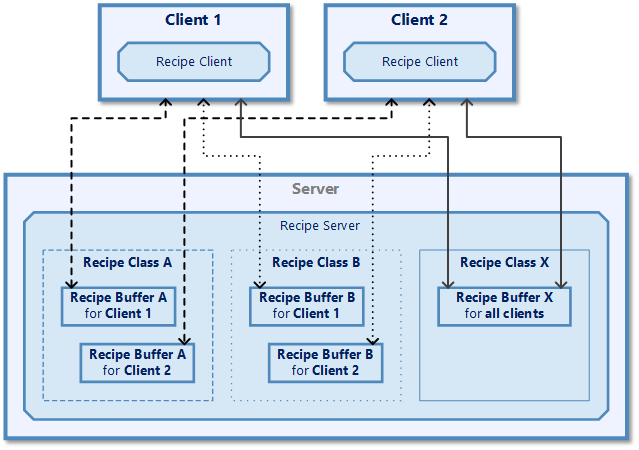
A recipe buffer is kept in the server for each recipe class. The management of this buffer is handled differently by the two available server types:
 Standard server
- The recipe buffer only exists once for each recipe class. This corresponds to recipe class X in the diagram. In an application with several clients, care should be taken during development to ensure that only one client accesses the buffer at any one time during runtime. Otherwise data inconsistencies may occur. The recipe class offers an interlocking function for access control.
 Cross-platform server
- The server provides a separate buffer for each recipe class and each client, so that several operators only have access to their own data. This corresponds to recipe class A and recipe class B in the diagram. For this reason, locking is not absolutely necessary. However, it should also be borne in mind that if two operators want to edit a recipe and send it to the PLC, the last one "wins". The difference to the standard server is that the content of the recipe buffer is consistent in itself and therefore also the data arriving in the PLC or the recipe file.