FAST.SysLog
This functionality has been available since version 3.32.0 of the L_IS1P_Security Library for using in combination with a c430, c520 or c550 controller from version 1.13.0.
The function block can be found in the library "Lenze/Interface/L_IS1P_Security." With this function block, the programmer can add customer messages to the SysLog log files on the controller, or send them to an external SysLog server via the SysLog client. For more information about SysLog handling on the controller
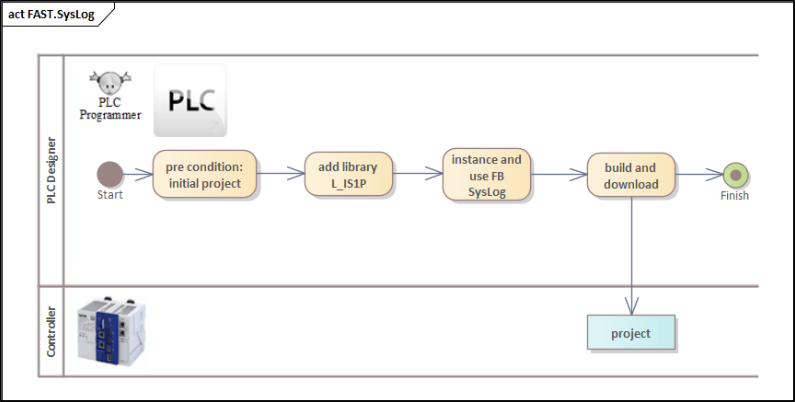
Activity Diagram
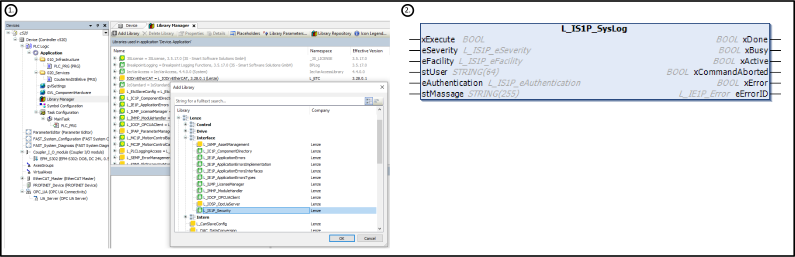
Integrate SysLog FB
Inputs of FB
|
Name |
Type |
|---|---|
|
xExecute |
BOOL |
|
eSeverity |
enum L_IS1P_Severity |
|
eFacility |
enum L_IS1P_Severity |
|
stUser |
STRING(64) |
|
eAuthentication |
enum L_IS1P_Authentication { none | successful |failed } |
|
stMessage |
STRING(255) |
xExecute
The message will be sent at rising edge.
eSeverity
The severity can be selected from the following list:
-
emergency = 0
-
alert = 1
-
critical = 2
-
error = 3
-
warning = 4
-
notice = 5
-
information = 6
-
debug = 7
-
none = 8
eFacility
The facility can be selected from the following list:
-
user = 1
-
auth = 4
stUser
The programmer can add the name of the user for the message. This can be used for the human user, but also for the software user to trigger the syslog message.
eAuthentication
The authentication Information can be selected from the following list:
-
none
-
successful
-
failed
stMessage
The Programmer can add a 255 character text for the message.
Outputs of FB
|
Name |
Type |
|---|---|
|
xDone |
BOOL |
|
xBusy |
BOOL |
|
xActive |
BOOL |
|
xCommandAborted |
BOOL |
|
xError |
BOOL |
|
eErrorID |
enum L_IE1P_Error |
These messages become visible in the log files of the controller:
-
<timestamp> localhost PLC application[....]: <date> <time>; <User>; <Authentication>; <Message>
-
The timestamp <date> and <time> indicates when the log was created in the application. The timestamp <timestamp> indicates when the log was written to the SysLog. There is a small queue in between. In most cases, the timestamps will match or differ only minimally.
The messages freely selectable by the programmer shall identify and handle error conditions in a manner that does not provide information that could be exploited by adversaries to attack the Device or Application.