Modbus TCP

Modbus is an internationally approved, asynchronous, serial communication protocol, designed for commercial and industrial automation applications.
–
Detailed information on the Modbus can be found on the web page of the international Modbus Organization, USA, who also further develop the Modbus protocol: www.modbus.org
–
Information about the dimensioning of a Modbus network can be found in the configuration document for the inverter.
Preconditions
The inverter is equipped with the "Modbus TCP" network option.
Details
–
The process of data transmission distinguishes between three different operating modes: Modbus ASCII, Modbus RTU and Modbus TCP/IP. This chapter describes the Modbus TCP/IP operating mode.
–
The Modbus protocol is based on a client/server architecture where the inverter always works as server (formerly known as a "slave").
–
In the Modbus TCP/IP network, a client (formerly known as a "master") can only address one server at a time. However, several clients can be available in the network.
–
Only a client can initiate the Modbus communication.
–
No direct communication takes place between the servers.
–
The network option supports the baud rates 10 Mbps (10 BaseT) and 100 Mbps (100 BaseT). The baud rate in the network is automatically detected.
–
The inverter supports the function codes 3, 6, 16 (0x10) and 23 (0x17).
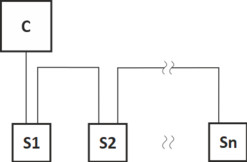
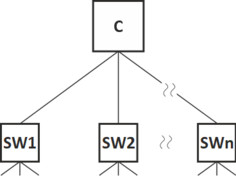
Typical topologies
|
Line
|
Tree
|
|
|
|
|
C
|
Client
|
SW
|
Switch
|
|
S
|
Server
|
|
|