Definition of an object in space
The function block L_TC2P_TrackingObject can be used to specify any moving object in room.
Connection of the conveyor belt
The object moves at the velocity of the conveyor belt. The conveyor belt is connected to the itfConveyorBelt input via the Axis_Ref axis.
Conveyor belt coordinate system
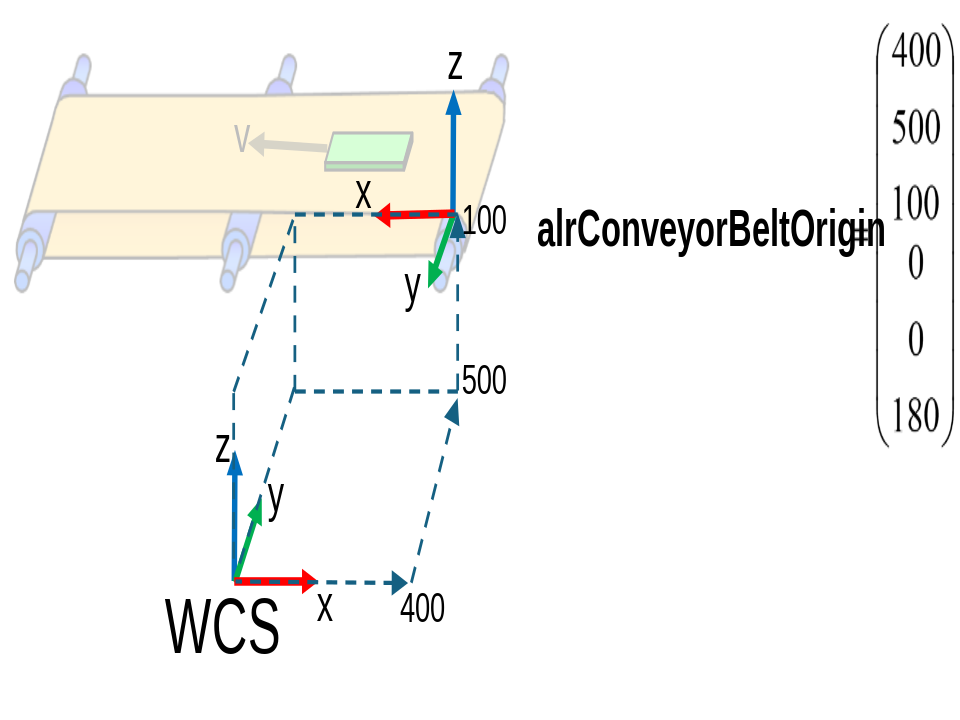
The alrConveyorBeltOrigin[1..6] input is used to define the location and orientation of the conveyor belt (the origin of the coordinate system and not the object). The location and orientation of the conveyor belt is defined in the world coordinate system (WCS). The X-axis of the conveyor belt must point in the positive direction of the conveyor belt travel.
Example
The conveyor coordinate origin is located in X = 400, Y = 500 and Z = 100. The X-axis is placed in the positive running direction of the conveyor. Thus, the orientation of the conveyor belt coordinate origin is rotated by C = 180° around the Z axis of the WCS.
Parameter field:
-
alrConveyorBeltOrigin[1] := 400; // Position in X direction [units]
-
alrConveyorBeltOrigin[2] := 500; // Position in Y direction [units]
-
alrConveyorBeltOrigin[3] := 100; // Position in Z direction [units]
-
alrConveyorBeltOrigin[4] := 0; // Position in A direction, rotation around X axis [deg]
-
alrConveyorBeltOrigin[5] := 0; // Position in B direction, rotation around Y axis [deg]
-
alrConveyorBeltOrigin[6] := 180; // Position in C direction, rotation around Z axis [deg]
Connection of the rotary table
The object moves at the speed of the rotary table. The rotary table is connected to the itfRotaryTable input via the Axis_Ref axis.
Rotary table coordinate system
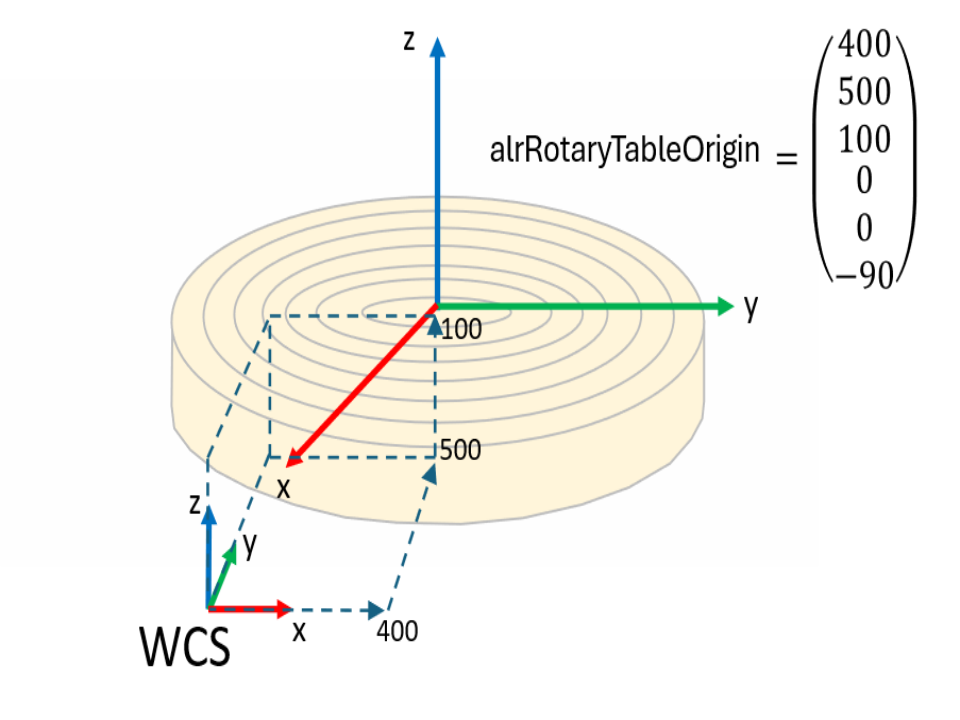
The alrRotaryTableOrigin[1..6] input is used to define the location and orientation of the rotary table (the origin of the coordinate system and not the object). The position and orientation of the rotary table is defined in the world coordinate system (WCS).
Example of a rotary table
The coordinate origin of the rotary table is at x = 400, y = 500 and z = 100. The coordinate origin is always at the origin of the rotary table.
Parameter field:
-
alrRotaryTableOrigin[1] := 400; // Position in x-direction [units]
-
alrRotaryTableOrigin[2] := 500; // Position in y-direction [units]
-
alrRotaryTableOrigin[3] := 100; // Position in z-direction [units]
-
alrRotaryTableOrigin[4] := 0; // Position in A-direction, rotation around x-axis [deg]
-
alrRotaryTableOrigin[5] := 0; // Position in B-direction, rotation around y-axis [deg]
-
alrRotaryTableOrigin[6] := -90; // Position in C-direction, rotation around z-axis [deg]
Position of the object in the coordinate system of a conveyor belt.
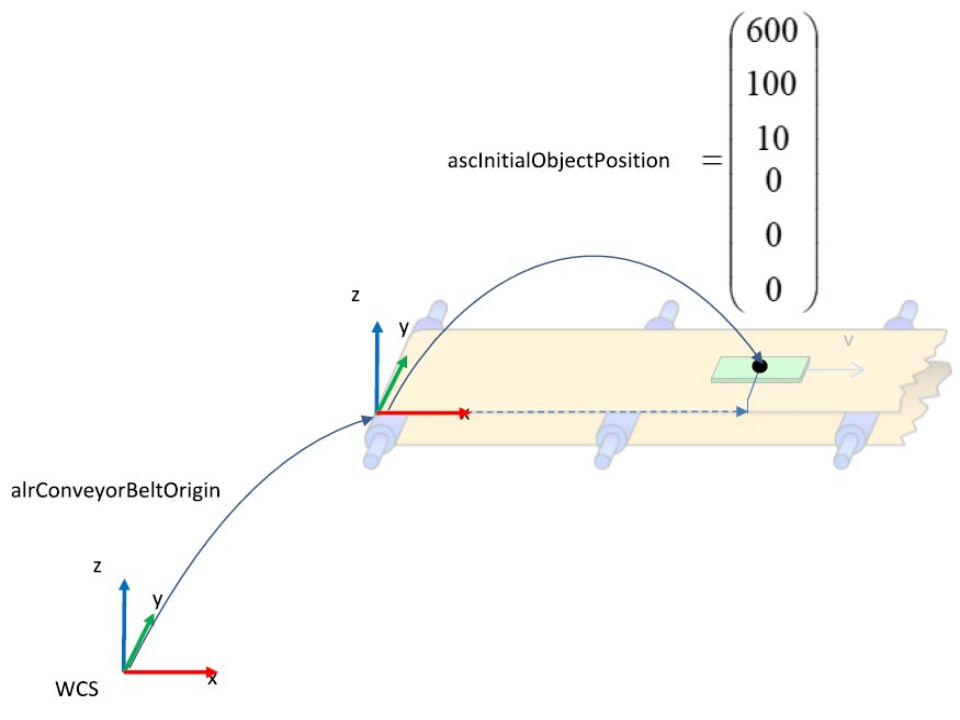
The position and orientation of the object's coordinates are specified by the alrInitialObjectPosition coordinates in the alrConveyorBeltOrigin coordinate system.
Example
The object is located at X = 600, Y = 100 and Z = 10 in the conveyor coordinate system. For the present example,
Parameter field:
-
alrInitialObjectPosition[1] := 600;
-
alrInitialObjectPosition[2] := 100;
-
alrInitialObjectPosition[3] := 10;
-
alrInitialObjectPosition[4] := 0;
-
alrInitialObjectPosition[5] := 0;
-
alrInitialObjectPosition[6] := 0;
Position of the object in the coordinate system of a rotary table
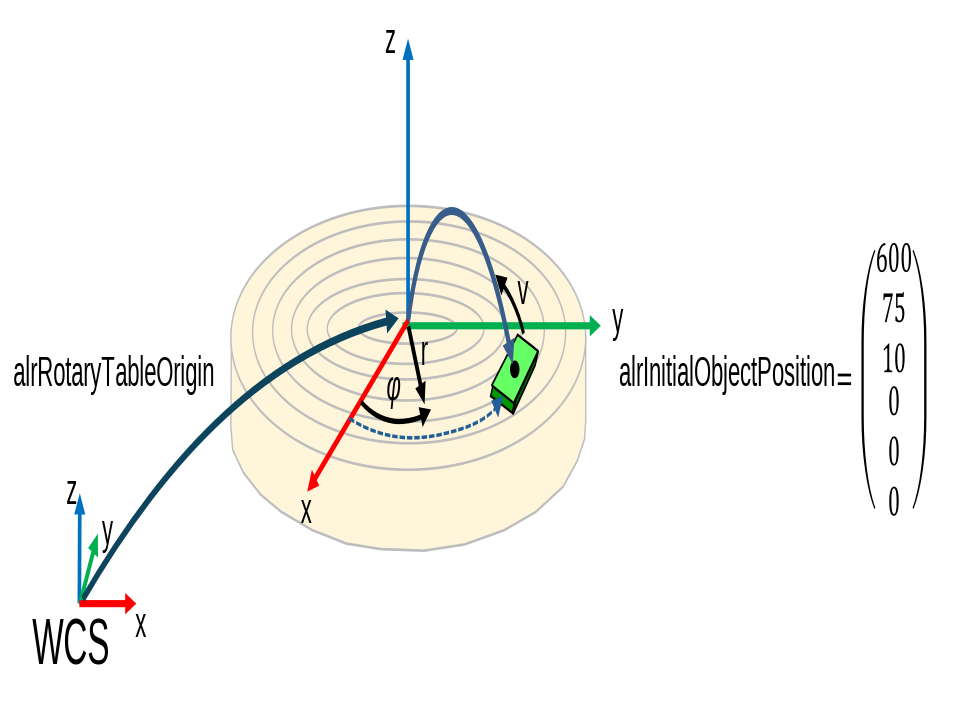
The position and orientation of the coordinates of the object are specified in cylindrical coordinates via the coordinates alrInitialObjectPosition in the coordinate system of the rotary table alrRotaryTableOrigin.
Example
The input for the object is entered from alrRotaryTableOrigin in cylindrical coordinates. The object is located at r = 600, φ = 100 and z = 10 in the rotary table coordinate system. The following results for this example
Parameter field:
-
alrInitialObjectPosition[1] := 600;
-
alrInitialObjectPosition[2] := 75;
-
alrInitialObjectPosition[3] := 10;
-
alrInitialObjectPosition[4] := 0;
-
alrInitialObjectPosition[5] := 0;
-
alrInitialObjectPosition[6] := 0;