Basics for identifying parameters via a model
Torque feedforward control can be calculated using a mechanical model. The parameters needed for this are:
- Masses, mass inertia values and centres of gravity of the robot components
- Coulomb friction and viscous friction
- Gravitation
If these parameters are known, the forces required for torque feedforward control during operation can be calculated for any robot motion. However, these parameters are not usually known or are not known in their entirety.
In this case, these parameters can be determined metrologically via an identification process. Parameter identification is a mathematical optimisation process which adapts the behaviour of the model to the actual system by varying model parameters.
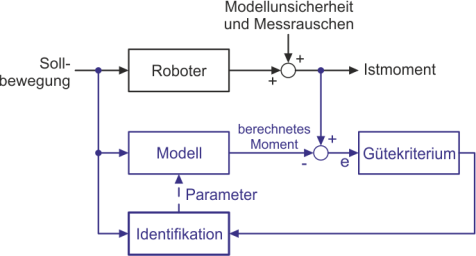
The parameters (e.g. friction and inertia) are adapted in the model from the value until the output of the model (e.g. torque) matches the actual output of the robot with sufficient precision. Thus, the identification routine uses a mathematical process to calculate the real parameters of the robot, which would otherwise be very difficult to calculate.
If the model acts like the real system on completion of the identification process, identification was successful.