Use of the (e)OrientationMode and (ae)Direction inputs for true-to-path movements
In the case of true-to-path movements (e.g. MC_MoveLinear..., MC_MoveCircular..., ...), the planning and interpolation of the movement is carried out on the virtual Cartesian axes of the WCS. For WCS axes that are parameterised as "Modulo" (usually Axis_A, Axis_B, or Axis_C), starting from library version 3.13.1.x it is possible to influence the direction of interpolation by the (e)OrientationMode and (ae)Direction FB inputs.
The following sequence diagram shows how the target position for the WCS axes is calculated as a function of the FB type (absolute position or relative distance) and the coordinate system parameterised at the FB.
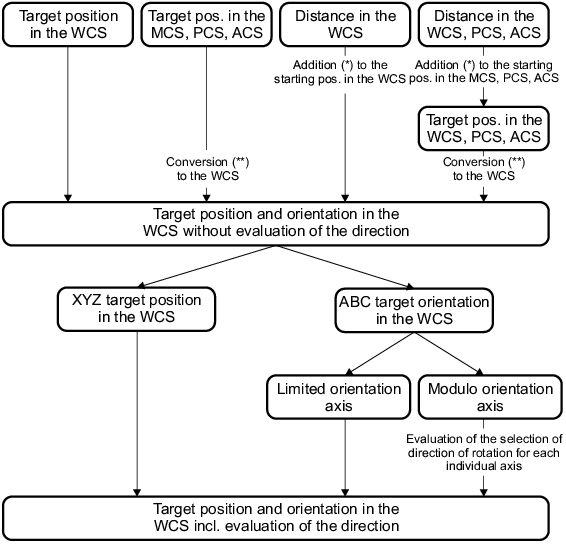
The following applies:
- Movements exceeding one revolution of a WCS orientation axis are only possible if the target position (or distance) is selected in the WCS coordinate system.
- Movements exceeding one revolution of a WCS orientation axis are only possible with "Limited" axes.
- A target position programmed in the ACS is not necessarily reached with a true-to-path movement. (See examples 3 and 4 further below)
When (e)OrientationMode := L_MC4P_Orientation_Mode.AxisIndividual, the selection of direction of rotation individual to each axis is evaluated on the basis of the description in MC_DIRECTION :
See also subindex 135 (tolerance window for Modulo positioning of the single axis).
With the selection of direction of rotation (e)OrientationMode:= L_MC4P_Orientation_Mode.ShortestSpacialWay, first the nearest possible combination of A, B, and C angles is calculated, which corresponds to the same end effector alignment as the target alignment programmed. Then all three orientation axes are traversed to the target position by the shortest path in each case.
Sample movements at the Scara_4dof axes group
Starting position for all following examples (Cartesian position values rounded):
|
A1 |
A2 |
A3 |
A4 |
X |
Y |
Z |
C |
|---|---|---|---|---|---|---|---|
|
10° |
15° |
0 mm |
30° |
362.45 mm |
103.33 mm |
0 mm |
-55° |
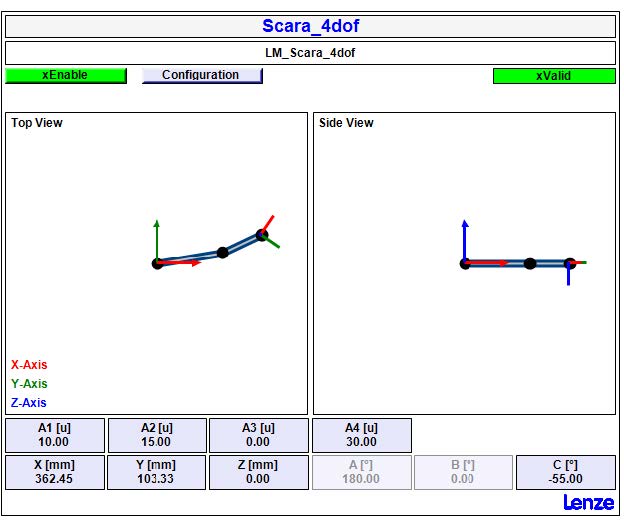
Example 1: MC_MoveLinearAbsolute , C axis "Limited", target position specified in WCS, path of the C axis <180°
The following target position is preselected in the WCS:
|
X |
Y |
Z |
A |
B |
C |
|---|---|---|---|---|---|
|
300 mm |
50 mm |
0 mm |
180° |
0° |
45° |
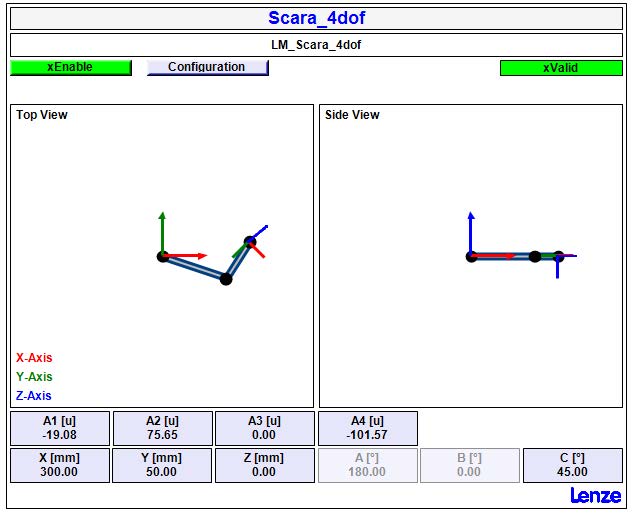
The target position and alignment is approached absolutely irrespective of the library version.
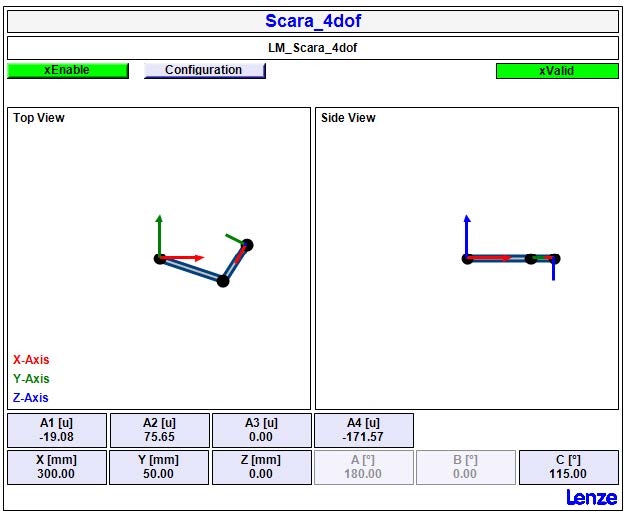
Example 2: MC_MoveLinearAbsolute , C axis "Limited", target position specified in the WCS, path of the C axis >180°
The following target position is preselected in the WCS:
|
X |
Y |
Z |
A |
B |
C |
|---|---|---|---|---|---|
|
300 mm |
50 mm |
0 mm |
180° |
0° |
475° |
|
Response up to library version 3.13.0 |
Response from library version 3.13.1 onwards |
|---|---|
|
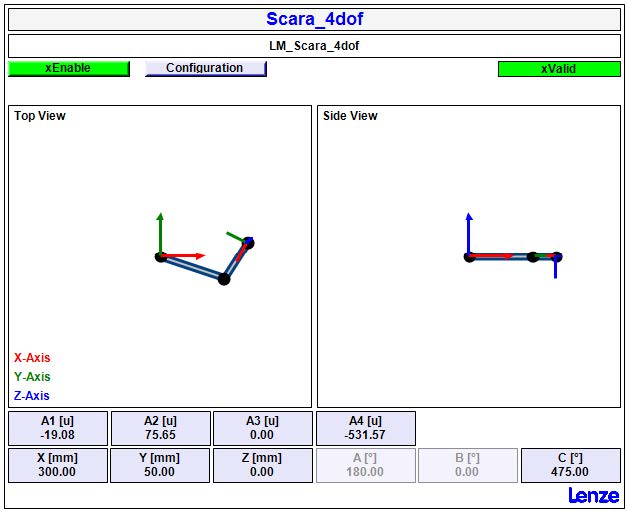
The C axis approaches the target orientation by the shortest path possible. The resulting target position of the C axis at the end of the positioning process is 115° and therefore does not equal the specification at the block. In total, the A4 drive axis rotates by -70° |
The C axis approaches the target orientation as specified at the FB. In total, the A4 drive axis rotates by -430°. |
|
|
In order to achieve the same response in this case (programmed C distances > 180°) with library version 3.13.1 as with versions 3.13 and older, the C axis must be changed to Modulo and at the Move FB the "Shortest path (default)" movement type must be selected.
Example 3: MC_MoveLinearAbsolute , target position 1 specified in the ACS
The following target position is specified in the ACS:
|
A1 |
A2 |
A3 |
A4 |
|---|---|---|---|
|
30° |
50° |
0 mm |
80° |
It can be reached from the given starting position along a linear movement.
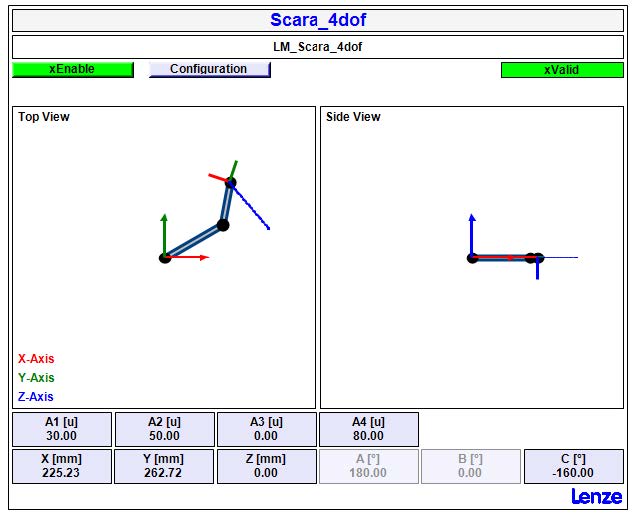
The target position of the ACS axis is approached along a linear movement irrespective of the library version.
Example 4: MC_MoveLinearAbsolute , target position 2 specified in the ACS
The following target position is specified in the ACS:
|
A1 |
A2 |
A3 |
A4 |
|---|---|---|---|
|
390° |
-310° |
0 mm |
80° |
The resulting Cartesian target position and orientation are identical to those in example 3. However, it is not possible to approach the programmed ACS position along a linear movement from the given starting position. The same ACS target position as in example 3 is approached instead.