Border H/HH/HHH, border L/LL/LLL
Specify which values of the monitoring variable are used to set bits in the output variable.
Area monitoring
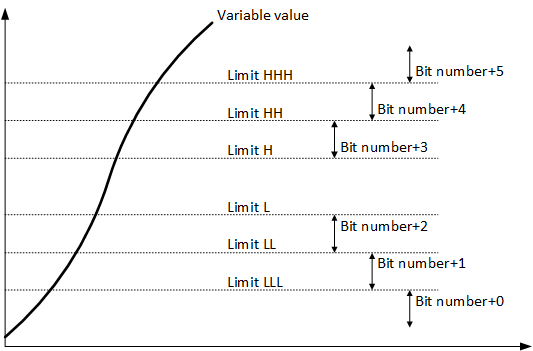
In range monitoring, the limits divide the variable range into a normal range and up to 6 monitoring ranges. No bit is set in the normal range (between limit L/H). Outside this range, the corresponding bit assigned to the range is set. This means that only one bit is ever active.
Limit value monitoring
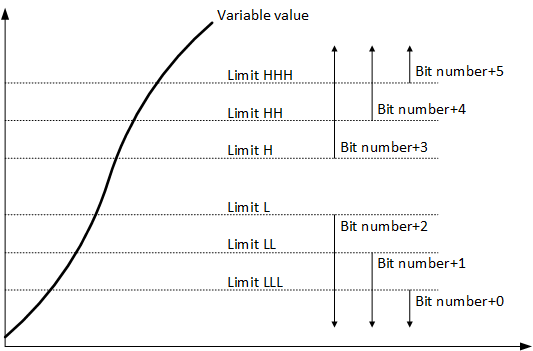
In limit value monitoring, the 6 limits are checked individually. If the variable value to be monitored is higher/lower than an upper/lower limit, the corresponding bit is set. This means that several bits can be active at the same time.
The graphics show the relationship between exceeding the limit and the bits in the output variable. If the value of the monitored variable exceeds one of the upper limits (HHH, HH, H) or falls below one of the lower limits (LLL, LL, L), a monitoring event is triggered.
The specification of the individual limits is optional. At least one limit should be specified (so that the definition fulfils a function at all). Care must be taken to ensure that the boundaries used are used from the outside inwards, i.e. if, for example, only two boundaries are to be used upwards, then values must be specified for the parameters boundary HHH and boundary HH. The value for limit HHH must be greater than the value for limit HH.
Either a constant value or the name of a variable is permitted as a limit. If a variable is specified, the value of the variable is used as the limit value. This makes it possible to dynamise the limit values at runtime.
Parameters for
- Process data monitoring module:
- Monitoring