BufferMode
For the BufferMode input, the following options are available which define the transition to the next command. The selection is made via the MC_BUFFER_MODE enumeration type of the "L_MC1P_MotionControlBasic" function library for which the following constants (INT) are defined:
|
Name |
Initial value |
Info |
|---|---|---|
|
mcAborting |
0 |
" Non-buffered mode " (standard behaviour): The new path motion aborts the current path movement.
|
|
mcBuffered |
1 |
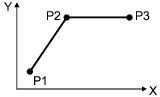
The next path motion is only executed if the previous path motion has been completed (status output Done = TRUE). |
|
Modes for blending |
||
|
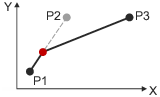
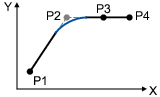
In the following modes, the next path motion will only be carried out too if the previous path motion has been completed (status output Done = TRUE). In contrast to the "Buffered" mode, however, blending takes place from the running path motion to the next path motion, i.e., the axes group is not stopped between the two motions. The velocity (and the other profile parameters) carried out by blending depend on the selected BufferMode: |
||
|
mcBlendingLow |
2 |
The transition to the next path motion is done with the lower velocity of the two path motions. |
|
mcBlendingPrevious |
3 |
The transition to the next path motion is done with the velocity of the running path motion. |
|
mcBlendingNext |
4 |
The transition to the next path motion is done with the velocity of the next path motion. |
|
mcBlendingHigh |
|
The transition to the next path motion is done with the higher velocity of the two path motions. |

|
Note!
For coordinated multi-axes movements, the buffer size is 100 geometric elements. The single FBs can consist of one or several geometric elements depending on the TransitionMode and the LookAhead . |
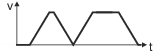
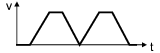
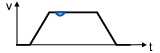
The following table shows the motion sequences and velocities of two successive path motions resulting for the TCP in three different modes:

|

|
|
|
|---|---|---|---|
|
|
BufferMode = Aborting |
BufferMode = Buffered |
BufferMode = Blending |
|
Motion sequence of the TCP |
|
|
|
|
TCP velocity |
|
|
|