Considering differential drives
To build smaller types of construction it often makes sense to use differential drives in robot kinematics. The use of differential drives in robot hand kinematics, for instance, results in higher flexibility of the machine. If such machines are used, the kinematic coupling between the drive axes must be considered in the kinematic transformation.
The following illustrations show schematic representations of the transformation between MCS and ACS and the extensions of the kinematics by the JCS by the use of a differential gearbox.
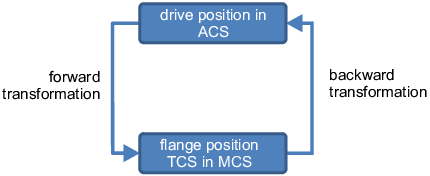
Transformations between ACS and MCS integrated in the axes groups
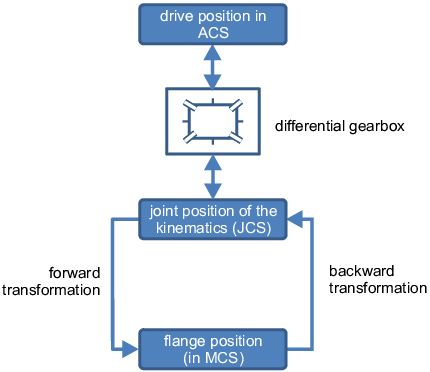
Extending the transformation by a differential drive

|
Note!
If a differential drive is used, the software limit positions of the drive axes continue to act on axial level (ACS = motor position x gearbox ratio), but not on kinematics level anymore. Coupled ACS axes must be of the Limited axis type if differential gearboxes are used (traversing range parameter (subindex 30 of the respective axis)). |
The following function blocks are provided for the extension of the transformation by differential drives:
 L_MC4P_DifferentialDrive2x2
- Kinematic coupling of two drive axes
- Kinematic coupling of up to three drive axes
|
|
Note!
Only one FB instance of the differential drives can be active on an axes group at a time. |