Security mechanisms
Product Defense in Depth
The following image shows the defense in depth product concept. For the sake of clarity, some details have been deliberately omitted.
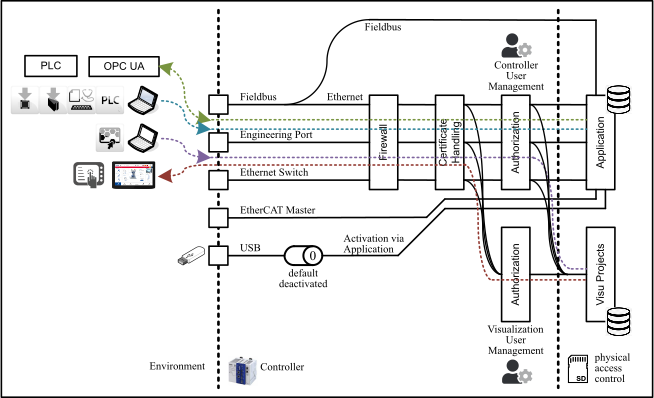
Product Defense in Depth
The core concept of the controller is that the Fieldbus, Engineering Port, and Ethernet Switch interfaces are assigned to two different user managements via a firewall. The Firewall minimizes the attack surface. The Certificate Handling takes over the certificate management for the respective encrypted connections.
-
Controller User Management
Connections to the OPC UA server and client, as well as to Lenze engineering tools such as PLC Designer, EASY Starter, and UI Designer, are authorized in the context of the controller's user management. All access to the controller is viewed via this user management. -
Visualization User Management
Only the visualization logins run via authorization in the context of the of the user management of the visualization runtime. All access by machine operators via a web panel to the visualization projects is viewed via this user management.
The Controller 2.x security architecture follows a layered defense-in-depth approach. External environmental and zone protection limits exposure of the controller. Secure-by-Default, Least Functionality and the Controller Firewall reduce the externally reachable attack surface. Controller User Management and role-based access rights restrict access to authorized users and functions. Encrypted communication and certificate handling protect communication channels. Input validation, application signing and Secure Boot provide additional protection against manipulation of data, applications and the controller platform. Security-relevant events and integrity violations are monitored by SysLog and handled by the Reaction Manager. These mechanisms provide complementary protection layers so that compromise or bypass of one protection mechanism does not automatically bypass the remaining security controls.
Special attention must be paid to fieldbuses. Protocols based on Ethernet are routed via the firewall, and access authorizations should be minimized as much as possible. Data via the fieldbuses themselves is not routed via the cyber security functions and runs directly into the application. Protection measures must be implemented within the component's environment.
The USB interfaces are deactivated by default. It is possible to activate the USB ports from the customer's perspective. Organizational measures are necessary here.
The SD card must be physically protected by an access control.
Expected Defense in Depth in the environment
The following image shows the Expected Defense in Depth in the environment of the controller.
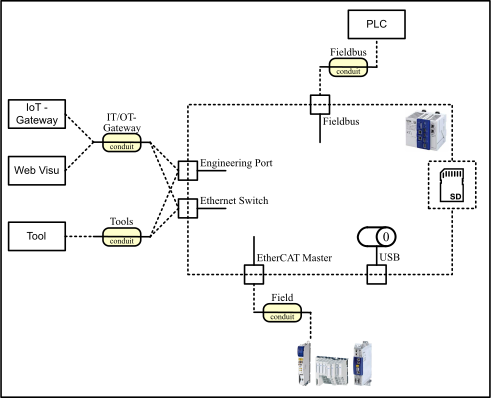
Expected Defense in Depth in the environment
Conduit IT/OT gateway:
-
An IT security-protected network environment is mandatory for operating these components. Operation on the Internet is not permitted.
-
An IT/OT gateway is recommended to limit the attack surface so that only the absolutely necessary accesses and protocols are enabled.
-
As these components cannot have any DoS / DDoS protection mechanisms from an embedded device perspective, these must be connected externally upstream.
Conduit Tools:
-
Access from the engineering tools to the components must be limited in terms of organization and time.
-
The corresponding engineering tools must be operated on an up-to-date and IT-security-secured computer.
Conduit Fieldbus:
-
In most cases, the actual classic fieldbus protocol does not include any mechanisms to safeguard cyber security.
-
Measures to safeguard confidentiality, integrity and availability must be provided by the customer.
Conduit Field:
-
In most cases, the actual classic fieldbus protocol does not include any mechanisms to safeguard cyber security.
-
Measures to safeguard confidentiality, integrity and availability must be provided by the customer.
General Environment:
-
General physical access protection must be provided for the components. This applies in particular to the SD cards in the controllers.
-
Existing firmware updates for the controllers as well as for all other components in the network should be installed immediately.
Security mechanisms:
The following security functions are included in the listed components:
-
Controller.SFTPServer
-
Controller.SSHServer
-
Controller.Firewall
-
Controller.UserManagement
-
Controller.EncryptedCommunication.PLCDesigner
-
Controller.Application.Encryption
-
Controller.CertificateStore.viaPLCDesigner
-
Controller.CertificateStore.viaAdvancedVisu
-
Controller.CertificateStore.HAProxy
-
Controller.WebDiagnosis
-
Controller.OPCUAServer.Authentification
-
Controller.OPCUAServer.Certificate
-
Controller.OPCUAClient.Authentification
-
Controller.OPCUAClient.Certificate
-
Controller.ComponentDirectory
-
Controller.NTP
-
Controller.WebVisu.Activation
-
Controller.WebVisu.Certificate
-
Controller.WebVisu.UserManagement
-
Controller.SysLog
-
Controller.USB-Stick