Square-law V/f characteristic
The square-law V/f characteristic is typically used in heating, ventilation and climate applications to control the speed of fans and centrifugal pumps.
Details
Each application that is provided with the features according to the affinity laws may possibly benefit from a square-law V/f characteristic.
The affinity laws describe the relation between the speed and other variables:
–
The volume flow increases proportionately to the speed.
–
The required pressure behaves proportionately to the square of the speed.
–
The power input is proportionately to the cube of the speed. This means that already a minimal reduction of the speed may lead to substantial savings in energy consumption.
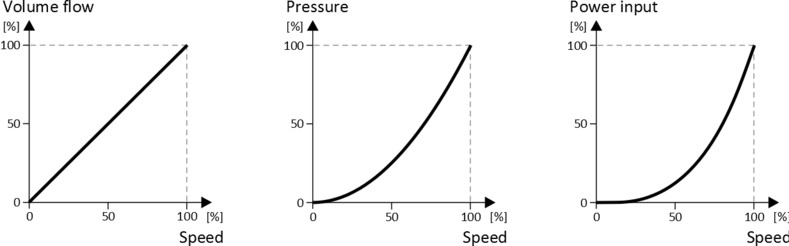
By approximation, the square-law V/f characteristic corresponds to the curve for power input shown above. At low frequencies, the voltage is reduced since due to the type of load a lower voltage is sufficient to generate the required power. All in all, this results in an energy-efficient system.
Select V/f characteristic control with square-law characteristic:
1.
Motor control mode 0x2C00 (P300.00) = "V/f characteristic control (VFC open loop) [6]"
2.
V/f characteristic shape 0x2B00 (P302.00) = "Quadratic [1]"
Setting of the V/f characteristic:
–
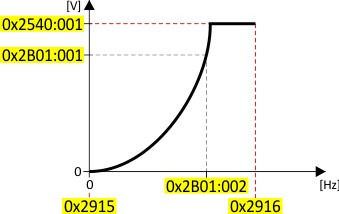
Limiting factors for the V/f characteristic are the rated mains voltage 0x2540:001 (P208.01), the minimum frequency 0x2915 (P210.00) and the maximum frequency 0x2916 (P211.00).
–
The base voltage 0x2B01:001 (P303.01) is usually set to the rated motor voltage (motor nameplate data). The base voltage is preset to the rated mains voltage. This in turn is preset according to the product key of the inverter.  Mains voltage
 –
The base frequency 0x2B01:002 (P303.02) is usually set to the rated motor frequency (motor nameplate data).

The actual output frequency can exceed the set maximum frequency if the gain for the slip compensation in 0x2B09:001 (P315.01) is set to a value higher than 0.