"Switch-off positioning" stop mode
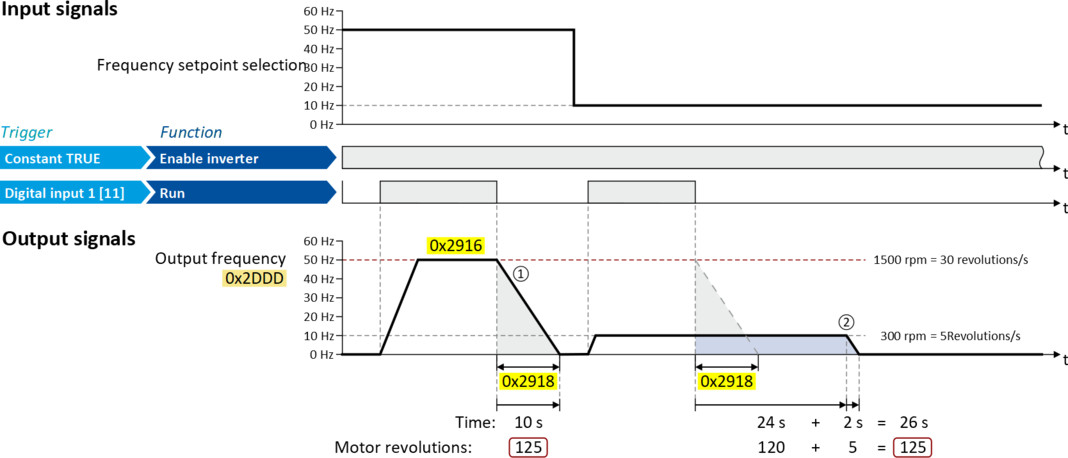
This stopping method is an extension of the stopping method "Standard ramp". A relatively consistent stop position can be achieved regardless of the current motor speed after a stop command using the "switch-off positioning". In this case, depending on the current output frequency, the inverter delays the beginning of the down-ramping so that the number of motor revolutions is always the same from the stop command to standstill.
Details
The stop method can be selected in 0x2838:003 (P203.03).  Stop behavior
 The number of motor revolutions to standstill depends on the rated speed of the motor, the set deceleration time and the set maximum frequency.
Example calculation:
–
4-pole 50 Hz motor with rated speed = 1500 rpm
–
Maximum frequency 0x2916 (P211.00) = 50.0 Hz
–
Deceleration time 1 0x2918 (P221.00) = 10.0 s

|
①
|
The motor is immediately brought to a standstill with the set deceleration time following a stop command if the output frequency corresponds to the set maximum frequency.
In the example, the motor reaches a standstill after 125 revolutions.
|
|
②
|
If the actual output frequency is less than the maximum frequency, the inverter delays the beginning of the down-ramping in order to reach the same number of motor revolutions to standstill, depending on the actual output frequency.
In the example, the down-ramping is initiated with a delay of 24 seconds in order to reach the number of 125 motor revolutions to a standstill.
|
Notes:
–
Two different ramps can be parameterized for the frequency setpoint. The speed compensation calculation is based on the deceleration time active at the time of the stop command, either deceleration time 1 or deceleration time 2.
–
No speed compensation is implemented if the deceleration time for the quick stop is active.
–
No adjustment is made to the speed compensation if the deceleration is changed from deceleration time 1 0x2918 (P221.00) to deceleration time 2 0x291A (P223.00) – or vice versa – during deceleration. The change-over is ignored.
–
The threshold for automatic change-over to acceleration time 2 and deceleration time 2 is ignored during deceleration if this stop method is selected.
–
If the motor accelerates or decelerates at the time of the stop command, the speed compensation is calculated based on the output frequency at that time.
–
There is a configurable stopping threshold 0x291E:003 (P226.03) that defines the speed range in which the stop function is active and NOT active. The stop threshold can be set from 0.0% to 100.0%. The percentage refers to the maximum frequency 0x2916 (P211.00). The standard setting for the threshold value for the speed compensated stop is 10.0%. The stop function is active when coming to a standstill from a speed greater than or equal to the stop threshold. The stop function is NOT active when coming to a standstill from a speed lower than the stop threshold; in this case, normal deceleration occurs.
–
The performance of speed compensation is dependent on several factors: the motor control type, the total capacity of the system mechanics, the mass inertia, the system friction, etc. These factors can influence the calculation of motor revolutions and the consistency. Since the mechanical and physical properties of the system cannot be influenced by the inverter, the system designer has to configure and test the speed compensation for suitability in the actual application.
–
The general relative performance can be estimated on the part of the inverter based on the selected motor control type:
|
Motor control type 0x2C00 (P300.00)
|
|||
|
V/f characteristic control (VFC open loop) [6]
|
Sensorless vector control (SLVC) [4]
|
Sensorless control (SL PSM) [3]
|
Servo control (SC ASM) [2]
|
|
Performance
|
|||

Parameter
|
Address
|
Name / setting range / [default setting]
|
Information
|
|
|
0x291E:003
(P226.03)
|
S-Ramp characteristic: Stop threshold
(S-ramp char.: Stop threshold)
0.0 ... [10.0] ... 100.0 %
–
From version 05.03
|
–
Configurable stop threshold value that defines the speed range in which the stop function is active and NOT active.
–
100 % = maximum frequency (0x2916 (P211.00)).
|
|