Thebasic actions read, write, load, save and send can be used to transfer recipe data between the recipe file, recipe buffer and variable server.
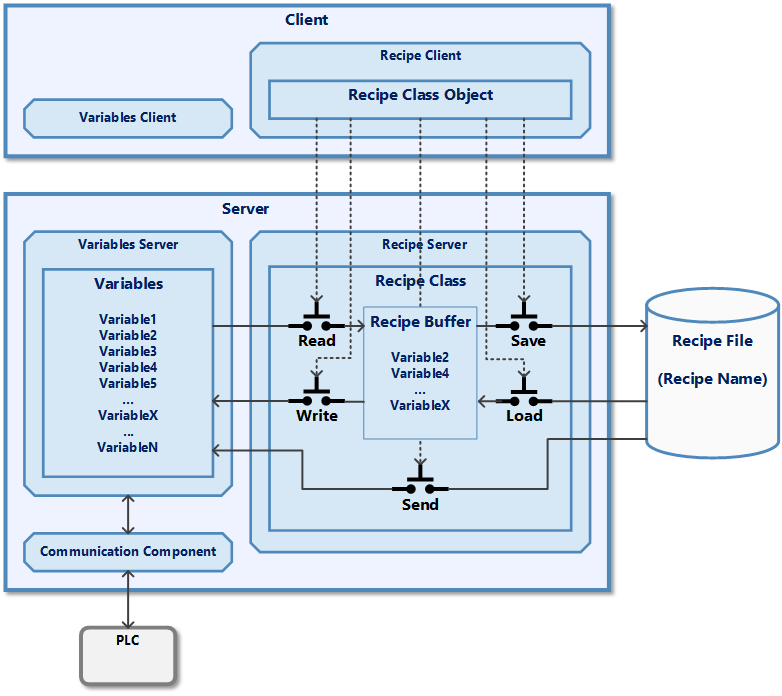
The recipe data can be transferred between the recipe file, recipe buffer and variable server using the following actions:
- Read
- The communication component cyclically updates the variable values in the variable server. The Readaction transfers a snapshot of these values to the recipe buffer.
- Writing
- The variable values from the recipe buffer are transferred to the variable server. This transfer is processed like a user input of a variable value, i.e. the variable server immediately writes the values to the PLC using the communication component.
- Loading
- The recipe values from a recipe file are loaded into the recipe buffer. The recipe nameof the recipe file must be specified for loading.
- Save
- All recipe data from the recipe buffer is saved in a recipe file. A recipe name must be specified for the recipe file before it can be saved.
- Send
- The recipe values from a recipe file are loaded directly into the variable server. The recipe buffer is bypassed and therefore does not change. The recipe name of the recipe file must be specified for loading. As with the Write action, the variable server transfers the values to the PLC using the communication component.
- Initialise
- Using the recipe class object, the recipe buffer can be initialised with fixed values (not shown in the image). Three options are available for the values:
-
- All variables are set to the default values of their data type:
falsefor Boolean variables,0for numeric variables,""(empty string) for text variables and01.01.0001 00:00:00( cross-platform server) or
30.12.1899 00:00:00( standard server) for date/time variables.
- All variables are set to the value of the Default value parameter from the recipe element definition.
- All variables are set to the value of the replacement value parameter from the variable definition.
- All variables are set to the default values of their data type:
These actions are triggered in the client by corresponding methods in the VisiWin API. The methods are provided by the recipe class object. An instance of this object is linked to a recipe class. As a result, the methods of this instance act on the associated recipe buffer of the recipe class or on the recipe class itself.