Acceleration compensation
Acceleration at the setpoint line velocity is a disturbance variable in the winding process. The torque that must be applied for acceleration is missing for the tensile force.
The acceleration torque must be calculated and pilot-controlled as additional torque.
The acceleration torque must be calculated and pilot-controlled as additional torque.
The effective additional torque resulting from the acceleration feedforward control is read via the parameter Setpoint torque acceleration compensation in [Nm] or via the parameter Effective set torque acceleration compensation in [%].
Parameters for acceleration compensation:
–
Setpoint torque for acceleration compensation 0x5051:124
–
Effective setpoint torque for acceleration compensation0x5051:125
0x5051:125
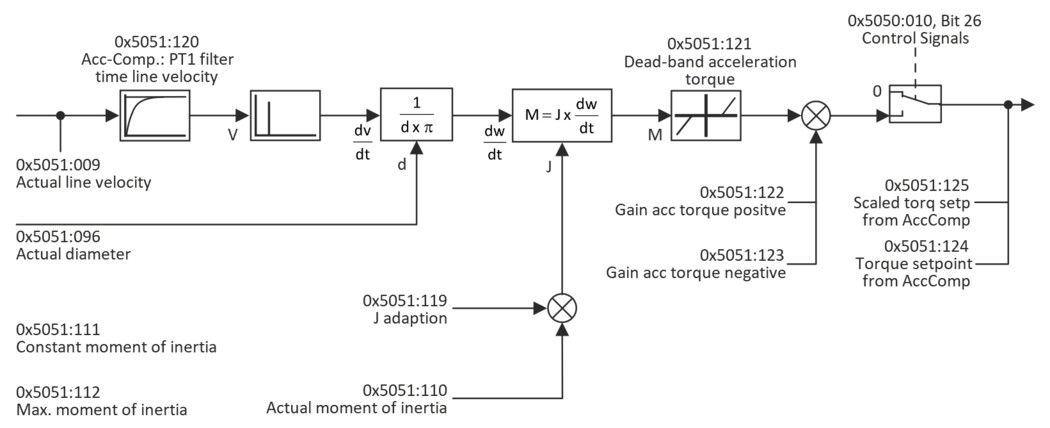
Fig. 1: Dialog overview "Acceleration compensation"
To calculate the acceleration, the line velocity must be differentiated. Via a PT1 functionality, unsteady velocity signals are smoothed before differentiation. The PT1 time constant is set via the parameter PT1 filter time acceleration compensation. 0x5051:120
0x5051:120
For noise suppression, a lost motion function is connected via the calculated acceleration torque.
How to prepare the acceleration compensation:
✓
✓
The values can be found in the DSD report.
1.
Set the parameter Max. moment of inertia of the winding shaft. 0x5051:112
0x5051:1122.
Set the parameter Constant moment of inertia of the motor. 0x5051:111
0x5051:111The acceleration compensation has now been prepared.
The motor moment of inertia typically dominates. The moments of inertia Constant moment of inertia and Motor moment of inertia are not equal.
When the unwinding direction is overcompensated for, the unwinder will be unwinding faster than the downstream process can accept, as a result of which slack will develop in the material.
How to configure the acceleration compensation:
1.
Set the acceleration torque in the unwinding direction with a factor < 100 % in the parameter Evaluation acceleration torque negative. 0x5051:123
0x5051:1232.
Set the acceleration torque in the rewinding direction with a value > 100 % via the parameter Evaluation acceleration torque positive. 0x5051:122
0x5051:122 Different mass inertias which result e.g. from different material widths or material densities are taken into account in the form of a percentage via the parameter Moment of inertia adaption. 0x5051:119
0x5051:119The acceleration compensation is enabled via the control bit 26 = TRUE. 0x5050:010 Bit 26
0x5050:010 Bit 26Parameter