Mark-controlled operation
In the mark-controlled operation, only one valid mark can be restored at a time. In this case, the target position (output lrTargetPos ) must be before the upper movement range limit (parameter lrUpperLimit ).
If the target position has already exceeded the upper travel range limit, a rising edge (FALSE ä TRUE) at the input xExecuteNextCut can be used to switch to the next mark in the mark stack. If there is no valid marker in the stack, then no target position is approached.
After a rising edge (FALSE ä TRUE) at the input xResumeTargetPos the target position is approached again.
Example
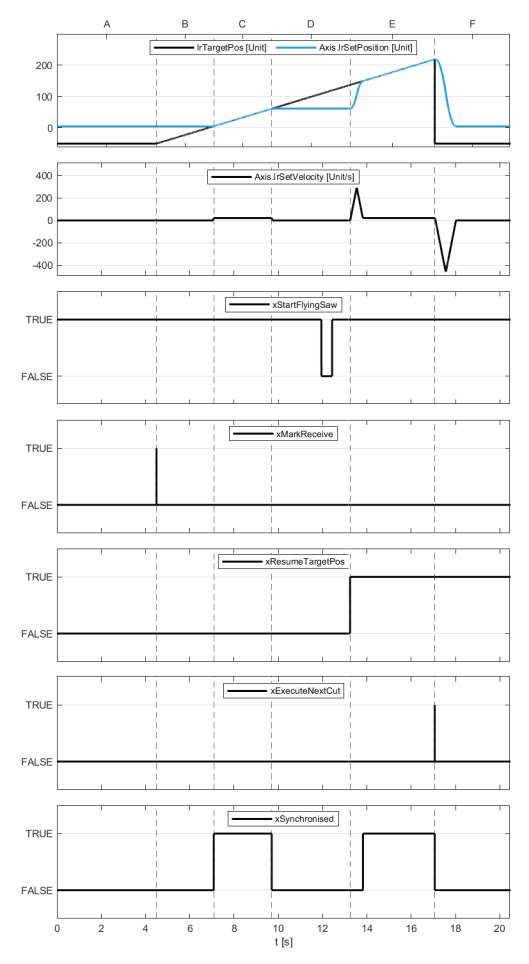
Example: Process "Restore target position" in mark-controlled operation
|
No. |
xStartFlying Saw |
xResume TargetPos |
xExecute NextCut |
xSynchronised |
Description |
|---|---|---|---|---|---|
|
A |
FALSE |
FALSE |
FALSE |
FALSE |
The master axis, and along with the material, is moved. The slave axis is at the left limit lrLowerLimit of the work area. |
|
B |
TRUE |
FALSE |
FALSE |
FALSE |
A mark is recorded. The target position is set to the sensor position lrMarkSensorPos . The target position lrTargetPos moves synchronously to the material velocity below the limit lrLowerLimit . |
|
C |
TRUE |
FALSE |
FALSE |
TRUE |
The target position lrTargetPos moves into the work area. The slave axis is synchronized to the target position lrTargetPos . |
|
D |
TRUE ä FALSE ä TRUE |
FALSE |
FALSE |
FALSE |
The technology module is stopped via the "Halt" or "Stop" function. In the background, the target position continues to run synchronously with the mark. The technology module is switched back to the "SAW_IN_PROCESS" state via the xStartFlyingSaw input. |
|
E |
TRUE |
TRUE |
FALSE |
FALSE ä TRUE |
The FALSE ä TRUE edge at the input xResumeTargetPos synchronizes the slave axis to the restored target position. |
|
F |
TRUE |
TRUE |
FALSE ä TRUE |
FALSE |
A FALSE ä TRUE edge at the input xExecuteNextCut normally moves to the next cutting position. Since there is no further mark in the stack, the target position jumps to the sensor position and remains there. The slave axis is positioned to the lower limit of the working range via the profile generator. |