Alarm states

Alarms can assume different states depending on the acknowledge mode. The three state bits of an alarm (defined by State variable and State variable bit number) are set according to the alarm state. There are six different states that can be assumed depending on the selected acknowledge mode:

State

State name for use in the source code or in the alarm filter

State (bit-coded)

Description

Acknowledge mode

Reset

Acknowledgment required

Double acknowledgment required

No acknowledgment required

inactive

Cleared

Filtering for this state is not possible.

000

The alarm is not active.

x

x

x

x

active

Active

100

The alarm is active.

x

x

x

x

active acknowledged

ActiveAck

011

The alarm is active. The user acknowledged the active alarm.

- **

x

x

x

inactive

Inactive

010

The alarm was active but is no longer active now. The user did not acknowledge the alarm when it was active.

-

x

x

-

inactive acknowledged

InactiveAck

001

The alarm was active. The user acknowledged the alarm when it was active. Now the alarm is no longer active. The deactivation of the alarm must also be acknowledged.

-

-

x

-

reactivated

Reactivated

Filtering for this state is not possible.

101

The alarm was inactive but became active again without being acknowledged. This state is not static. It is just reported. The alarm assumes the active state again.

-

x

x

-

** Acknowledging an alarm in this acknowledge mode resets the event bit directly. This is only possible if the bit is not permanently kept in the same state by the PLC.

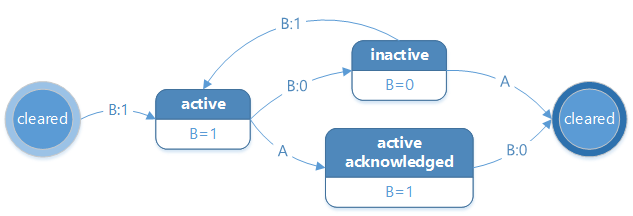
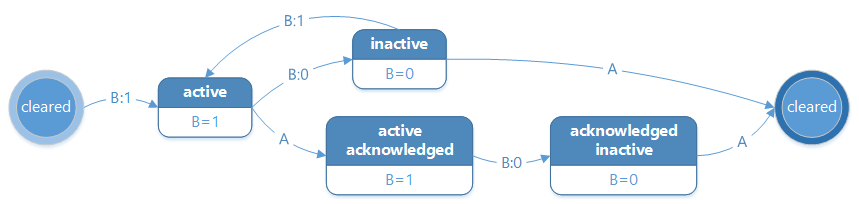
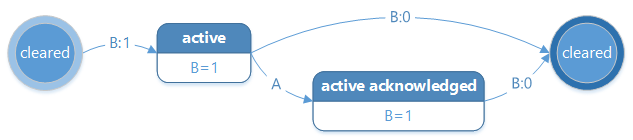
The acknowledge modes are illustrated by the flowcharts below:

Flowchart of the Reset acknowledge mode

Reset

Flowchart of the Acknowledgment required acknowledge mode

Acknowledgment required

Flowchart of the Double acknowledgment required acknowledge mode

Double acknowledgment required

Flowchart of the No acknowledgment required acknowledge mode

No acknowledgment required

The abbreviations used in the above charts have the following meanings:

B:1

Event bit is set (e.g. by the PLC)

B:0

Event bit is reset (e.g. by the PLC)

B=0

Event bit state = 0

B=1

Event bit state = 1

A:

Alarm is acknowledged

Related topics: