Execution of an identification
-
The deceleration cannot and must not normally be increased above the system-specific maximum! Only the jerk may be increased for these test runs in consultation with the machine manufacturer.
Excitation of the mechanics
To determine both parameters, the structure must be excited to oscillate with the compensation switched off. There are two ways to do this:
-
Run the drive of the structure at the usual speed and then decelerate the drive with as high a jerk as possible.
-
Operate the drive with a normal movement with increased jerk values.
A "normal movement (i.e. positioning) can already contain a temporal sequence of the acceleration change, which leads to a compensation of the vibration! Therefore, if the vibration frequency is unknown, a short movement profile must be determined in which the vibration is particularly pronounced at standstill and can be recorded.
Generate sensor information
If the axis is then at a standstill, the vibration can be measured using an external measuring device (e.g. acceleration sensor or external position sensor). The signal should be as free of mean values as possible, i.e. the measured values should be evenly distributed around zero.
If no external measuring equipment is available, the current torque of the axis or the following error can often be used as an alternative.
Evaluating the measurement signals
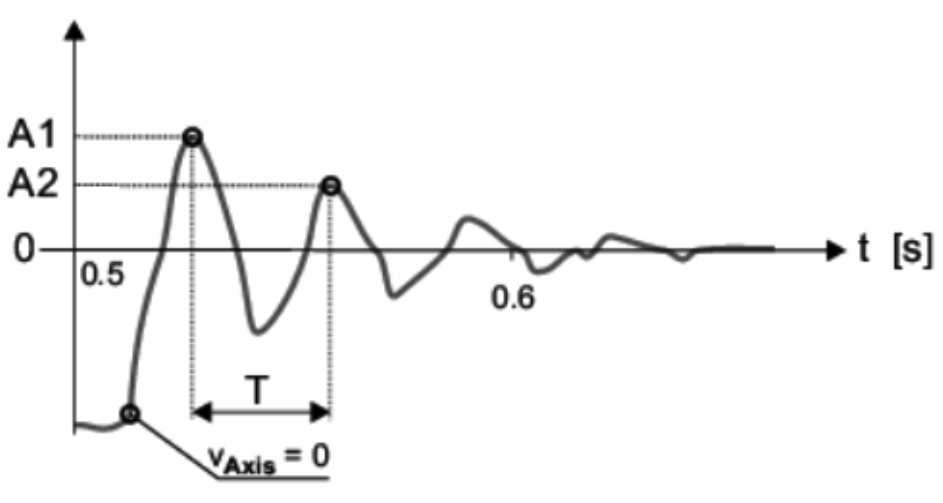
|
A1 |
Amplitude of the first oscillation |
|---|---|
|
A2 |
Amplitude of the second oscillation |
|
T |
Time for one oscillation (period duration) |
Calculations of the natural frequency: lrEifgenFreq = 1/T
Determination of the amplitude ratio: lrAmpRatio = A2/A1