Speed-dependent evaluation of the motor current
 WARNING!
Fire hazard by overheating of the self-ventilated standard motor
Possible consequences: Destruction of system parts
▶
Protect self-ventilated standard motors especially at low speeds by sufficient cooling or from impermissibly high motor currents. Carry out a speed-dependent evaluation of the permissible motor current.
WARNING!Fire hazard by overheating of PM synchronous motors
Possible consequences: Destruction of system parts
▶
Please check for every individual case which r.m.s. value can be used to permanently operate the motor at standstill. In case of some motors, a derating I1/In < 100 % is required when n1/nn = 0 %. This serves to prevent an overload of individual motor phases as their power loss doubles with continuous DC current load. (It is called DC current load as the field frequency amounts to 0 Hz at standstill.)

When you select a Lenze motor from the catalogue and transfer its parameters into the i700 servo inverter a typical characteristic is automatically set for the selected motor. A deviating parameterisation is only required if the motor is operated in ambient conditions which demand a general derating. Example: use in site altitudes > 1000 m. In case of motors of other manufacturers, the operating points have to be parameterised based on the data sheet information.
By selecting a characteristic, the permissible motor current is evaluated depending on speed for calculating the thermal motor utilisation. For this purpose, up to four operating points on the S1 characteristic of a motor can be used.
–
The S1 characteristic can be found in the technical data sheet/catalogue of the respective motor.
–
The representation in the objects /characteristic is carried out as relative values with reference to rated values.
The speed-dependent evaluation of the permissible motor current can actually be switched off by parameterising all 8 characteristic points to "100 %".
|
Operating points
|
||
|
①
|
Standstill n01-I01
|
For motors, this operating point is often described with the no-Io values.
|
|
②
|
Reference point n02-I02
|
If the value falls below the speed n02, a derating in the current is required because:
–
the motor cooling of self-ventilated motors deteriorates considerably.
–
a DC current load causes an increased power loss in a winding.
–
For motors, this operating point is also described with the no-Io values.
|
|
③
|
Rated point (n03=nN)-(I03=IN)
|
Rated values of the motor are the reference for all operating points of the i2xt monitoring.
|
|
④
|
Field weakening n04-I04
|
This operating point should be parameterised irrespective of the use in the current application.
|
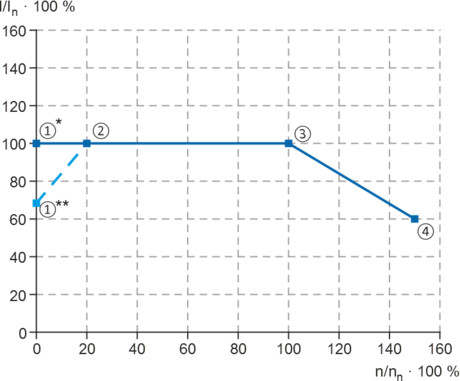
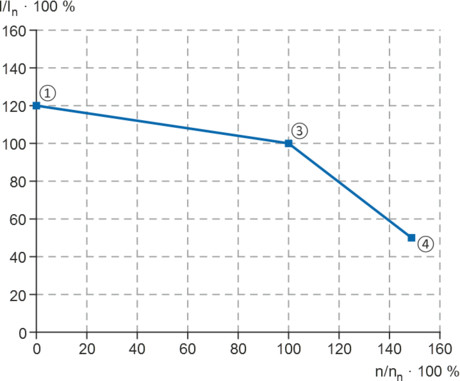
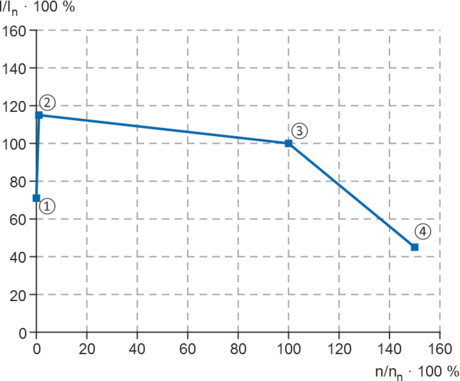
Example of how to enter the characteristic for standard and servo motors
The required data of the operating points result from the S1 characteristic of the prevailing motor:
|
Examples of S1 characteristics
|
|
|
Standard motor
|
|
|
|
*forced ventilated standard motor
**self-ventilated standard motor
|
|
Servo motor
|
Servo motor with derating at standstill
|
|
|
|
|
Parameter
|
Characteristic points
|
Info
|
|
|
①
|
n1/nn * 100 %
|
Speed = "0" (standstill)
|
|
|
I1/In * 100 %
|
Permissible motor current at standstill
|
||
|
②
|
n2/nn * 100 %
|
Speed from which the current must be reduced for self-ventilated motors.
–
Below this speed the cooling air flow of the integral fan is not sufficient anymore.
|
|
|
I2/In * 100 %
|
Permissible motor current at speed n2 (torque reduction)
|
||
|
③
|
n3/nn * 100 %
|
Rated speed
|
|
|
I3/In * 100 %
|
Permissible motor current at rated speed
|
||
|
④
|
n4/nn * 100 %
|
Speed above the rated speed (in the field weakening range for asynchronous motors)
|
|
|
I4/In * 100 %
|
Permissible motor current at speed n4 (field weakening)
|
||
Parameter