Set oscillation damping
The oscillation damping serves to reduce the oscillations during no-load operation
which are caused by energy oscillating between the mechanical system
(mass inertia) and the electrical system
(DC bus). Furthermore, the oscillation damping can also be used
to compensate for resonances.

Damping is possible only for constant oscillations at a steady-state
operating point.
Oscillations occurring sporadically cannot be damped.
Oscillation damping is not suitable for oscillations occurring during dynamic processes (e.g. accelerations or load changes). Oscillation damping is only active if the setpoint speed is greater than 10 rpm and the DC-bus voltage exceeds a value of 100 V.
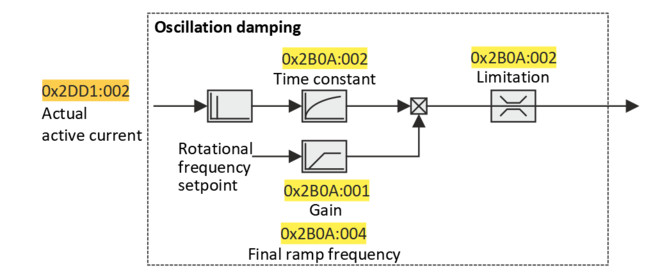
The determination of the oscillation is based on the active current. In order to obtain the alternating component of the active current, this current is differentiated. This signal is then passed through a PT1 filter.
Identification of the oscillation
Before the oscillation damping can be parameterised, the oscillation must be identified. One option is to look at the motor current when the oscillation damping is switched off (gain = 0 %). The oscilloscope function of the »PLC Designer« enables to record the following currents:
A passive load and continuous operation with constant speed (steady-state operation) result in a constant current. If the drive oscillates, the motor current oscillates as well. This makes it possible to detect the frequency and amplitude of the oscillation by means of the AC component in the motor current. Hereinafter this AC component will be referred to as "current oscillation".
Parameter setting
The gain of the oscillation damping is to be set according to the following equation:

The time constant must be set so that the oscillation can be dampened, but that higher-frequency components are filtered from the signal. The time constant is determined from the reciprocal value of the double current oscillation frequency:

The calculated oscillation frequency can be limited before being added to the rotating field frequency. The maximum frequency can be derived from the amplitude of the current oscillation, the rated motor current and the slip frequency of the connected motor:

Parameter