Mark stack master value correction
The mark stack is always required if, due to the design, the sensor cannot be mounted within one cycle in front of the tool (e.g. cutting blade, print heads). scPar.lrSensorToolDistMaster > scPar.lrProductLength )
The function ensures that the detected mark is only evaluated if it is located in the cycle in front of the tool. Simply put, the mark sensor is moved virtually to the position exactly one cycle in front of the tool. The tool may be mounted a maximum of 64 cycles in front of the tool. The length of the mark stack is calculated as follows.
Mark stack length = s cPar.lrSensorToolDistanceMaster - scPar.lrProductLength
The aim should always be to mount the mark sensor as close as possible to the tool. The farther away the mark sensor is mounted from the axis, the more changes in the material flow remain undetected and cause cutting inaccuracies.
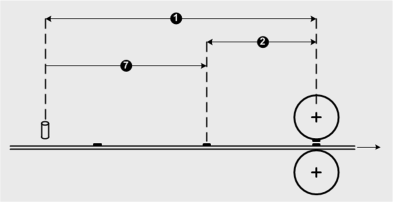
Systematic representation of the mark register
|
❶ |
Parameter lrSensorToolDistMaster |
|
❷ |
Parameter lrProductLength |
|
❼ |
Länge des Marken-Stack |
Parameters relevant for the function
-
scPar.lrSensorToolDistMaster
-
scPar.lrProductLength
Example
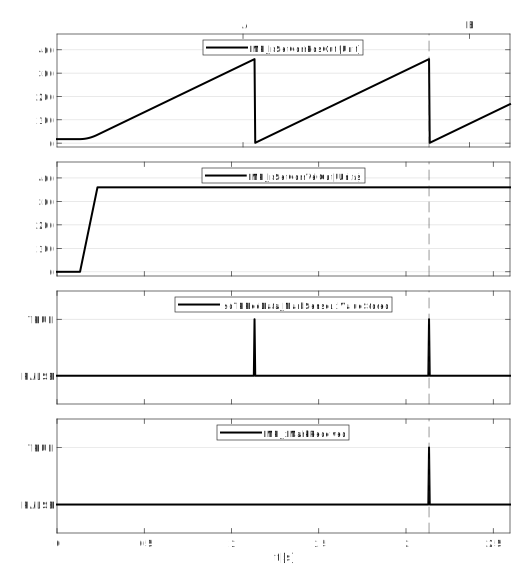
|
No |
scTPRecData_MarkSensor.xValueStored |
scSignalFlow.MP_xMarkReceived |
INFO |
|---|---|---|---|
|
1 |
FALSE ä TRUE |
FALSE |
The first mark has occurred and is saved in the mark stack. |
|
2 |
FALSE ä TRUE |
FALSE ä TRUE |
The first mark has left the mark stack. The length of the mark stack can be read off by the distance covered between scSignalFlow.MP_lrSetCorrPosOut[1] and
|