
|
Tip |
|---|---|
|
The version of the function block as described here corresponds to the latest version of the function block in Version list of function blocks. |
SF_SafetyRequest is a certified PLCopen function block. For detailed information about applied standards, see "PLCopen – Technical Committee 5 – Safety Software".

|
Important |
|---|---|
|
The requirements listed in the standards must be fulfilled by the user. |
The SF_SafetyRequest function block represents the interface between the user program and the system environment. It provides the interface to a general actuator (for example, a safety drive or a safety valve) to set it to the safe state.
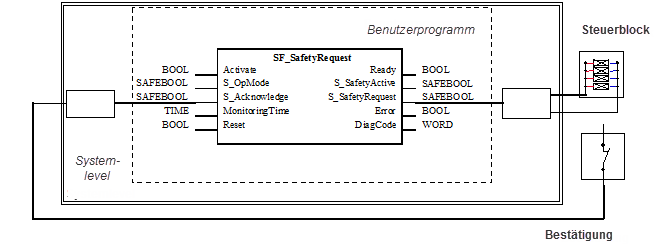
Table 72. VAR_INPUT
|
Name |
Data Type |
Initial Value |
Description, parameter values |
|---|---|---|---|
|
|
|
|
|
|
|
|
|
Variable. Requested mode to the connected peripheral.
|
|
|
|
|
Variable Confirmation of the connected peripheral.
|
|
|
|
|
Constant. Monitoring of the response time between the request of a safety function ( The MonitoringTime caution note must be observed. |
|
|
|
|

|
MonitoringTime |
|---|---|
|
For developers in Extended Level: The |
Table 73. VAR_OUTPUT
|
Name |
Data Type |
Initial Value |
Description, parameter values |
|---|---|---|---|
|
|
|
|
|
|
|
|
|
Confirmation of the safe state
|
|
|
|
|
Request to set the peripheral in the safe state
|
|
|
|
|
|
|
|
|
|
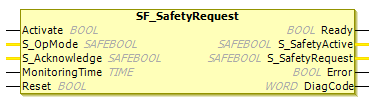
This function block represents the interface between the safety-oriented system and the connected safe peripheral. This means that the safety functions of the connected safe peripheral are available in the user program (application). However, there are only 2 binary signals to control the safe state of the connected peripheral (i.e. one signal for the request and one signal for the receipt of the acknowledgement).
|
|
Important |
|---|---|
|
The safety function is performed independently by the connected safe peripheral. The |
|
|
Tip |
|---|---|
|
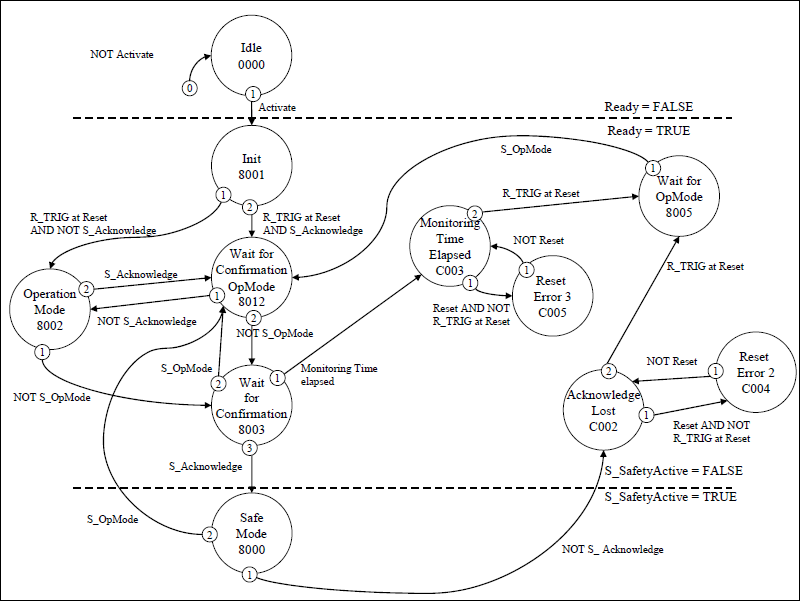
Note: The transition from any state to the |
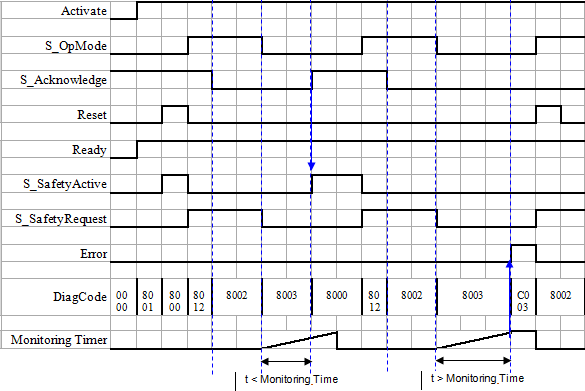
The function block detects if the actuator does not enter the safe mode within the monitoring time.
The function block detects when the acknowledgement signal is lost, although the request is still active.
The function block detects a static Reset signal.
External device errors: There are no external errors because there are no error bits/error information provided by the connected safe peripheral.
In case of an error event, the S_SafetyActive output is set to FALSE.
An error must be acknowledged with a rising trigger edge at the Reset input. To continue with the function block after this Reset, the S_OpMode request has to be set to TRUE.
Table 74. FB-specific error codes
|
|
Statue Name |
Status description and output setting |
|---|---|---|
|
|
|
Switching off the acknowledgement in the safe state
|
|
|
|
The
|
|
|
|
Static reset detected in status
|
|
|
|
Static reset detected in status
|
Table 75. FB-specific status codes
|
|
Statue Name |
Status description and output setting |
|---|---|---|
|
|
|
The function block is not active (basic state).
|
|
|
|
Peripheral (actuator) is in safe mode.
|
|
|
|
Status after Activate was set to
|
|
|
|
Operating mode without acknowledgement of safe mode.
|
|
|
|
Operating mode with acknowledgement of safe mode
|
|
|
|
Wait for acknowledgement of the drive (system interface)
|
|
|
|
Error was acknowledged. Nevertheless,
|