Friction compensation

Oil-filled toothed gearboxes exhibit friction of approx. 2 [%] per gearbox ratio
The friction is influenced by the winder mechanics. The friction is dependent on the speed. When small torques are configured precisely, a friction compensation is required. The compensation is achieved by adding an additional torque in the Friction compensation - torque parameter field.  0x5052:121
The simplified friction compensation is activated by default. The simplified friction compensation does not have to be identified. For the simplified friction compensation, a starting value and a final value must be defined. The value is calculated between these two known values.
|
Value
|
Parameter name
|
Parameter
|
|
Starting value
|
Start Value
|
|
|
Final value
|
End Value
|
 0x5052:035
If the mechanics exhibit a non-linear friction characteristic, the friction characteristic will need to be identified. Identifying the friction characteristic
Identifying the friction characteristicThe friction compensation parameter: Method selection is used to select the identified friction characteristic for the compensation. Friction curve - value 0x5052:046, 047, 048, 049, 050, 051, 052, 053, 054, 055, 056, 057, 058, 059, 060, 061, 062, 063, 064, 065, 066, 067, 068, 069, 070, 071, 072, 073, 074, 075, 076, 077, 078, 079, 080, 081, 082, 083, 084, 085, 086, 087, 088, 089, 090, 091, 092, 093, 094, 095, 096, 098, 099, 100, 101, 102, 103, 104, 105, 106, 107, 108, 109, 110, 111
0x5052:046, 047, 048, 049, 050, 051, 052, 053, 054, 055, 056, 057, 058, 059, 060, 061, 062, 063, 064, 065, 066, 067, 068, 069, 070, 071, 072, 073, 074, 075, 076, 077, 078, 079, 080, 081, 082, 083, 084, 085, 086, 087, 088, 089, 090, 091, 092, 093, 094, 095, 096, 098, 099, 100, 101, 102, 103, 104, 105, 106, 107, 108, 109, 110, 111Friction compensation via the reference speed
The characteristic of the friction compensation is derived from the line speed signal. This line speed signal provides a reference speed. Hence, the compensation is based on the setpoint value. The friction compensation can be stabilised by filtering the reference speed. The filter time is configured in the Friction compensation - filter reference speed. 0x5052:037
0x5052:037
Long filter times limit the dynamics of the friction compensation.
Friction compensation via torque
When bit 25 of the control signals parameter = TRUE is set, the torque of the friction is added to the total torque. The torque of the friction is adapted multiplicatively to the total torque with the parameter Friction curve: Adaptation.
|
Function
|
Parameter name
|
Parameter index
|
|
Control word
|
Control signals
|
0x5050:010
|
|
Multiplicative adaptation
|
Friction curve adaptation
|
The effective direction of the compensation torque changes when winding or unwinding. The adaptation takes place automatically.
Parameter
When the system is at a standstill, the line velocity is 0. The winding direction is not automatically detected. The effective direction of the friction compensation can be controlled manually.
Set control bit 27 to TRUE or to FALSE to set the direction of rotation from standstill.
–
To reduce the unwinding process, set control bit 27 = TRUE of parameter Control signals. Friction compensation has a reducing effect on the total setpoint torque. The material can be unwound. 0x5050:010
–
To reduce the winding process, set control bit 27 = FALSE of parameter Control signals. Friction compensation has a reducing effect on the total setpoint torque. The material can be wound up. 0x5050:010
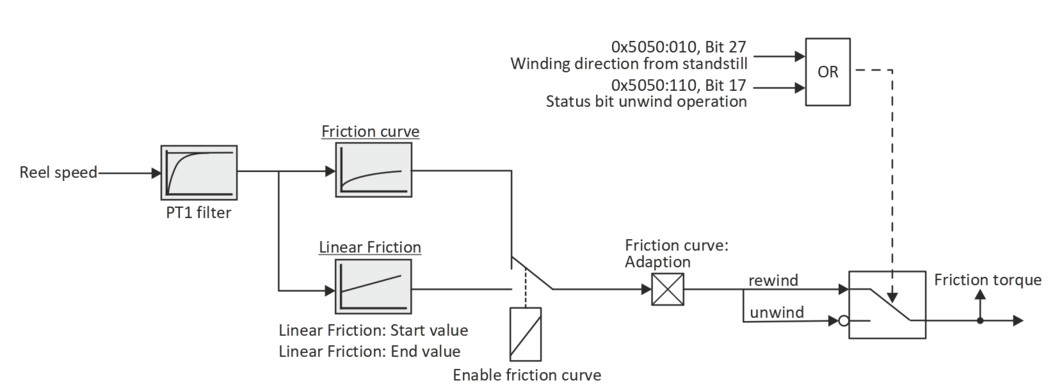
Fig. 1: Signal flow of the friction compensation