i9x0.Application.Encryption
This functionality has been available from version 2.0.0 on.
With the help of this function, the application of the i9x0 Servo Inverter can be encrypted. These include:
-
the application itself
-
the online change
-
the boot application.
The system integrator can use this functionality to protect its intellectual property and thus the of its applications source code.
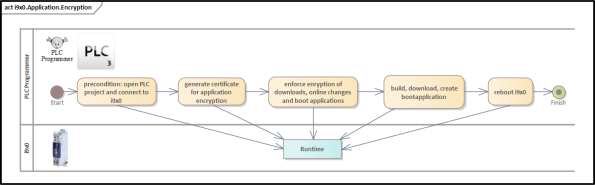
Activity Diagram
In order to use this functionality, a certificate for the application encryption is generated. This is done as shown in the following image.
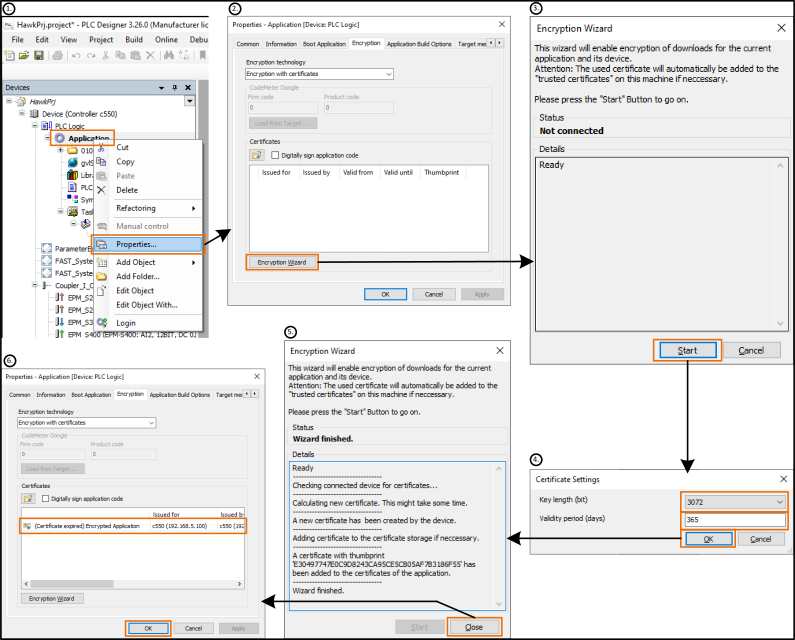
Encryption Wizzard
In order to generate a certificate for the encrypted application, the following steps must be carried out:
-
Open the PLC Designer project and select the Application item in the Devices Tree and call up the ‘Properties...’ entry.
-
Call the Encryption Wizard in the following dialog. Please select the encryption technology ‘Encryption with certificates’.
-
Start the Encryption Wizard.
-
Enter the key length and the validity of the certificate term and confirm with OK.
-
Information about the generated certificate is shown. The thumbprint of the certificate is shown to identify the certificate.
-
The generated certificate appears in the origination window and is now available.
To enforce the encryption of the application, select the setting ‘Enforce encryption of downloads, online changes and boot applications’ in the PLC Designer in the Security Screen.
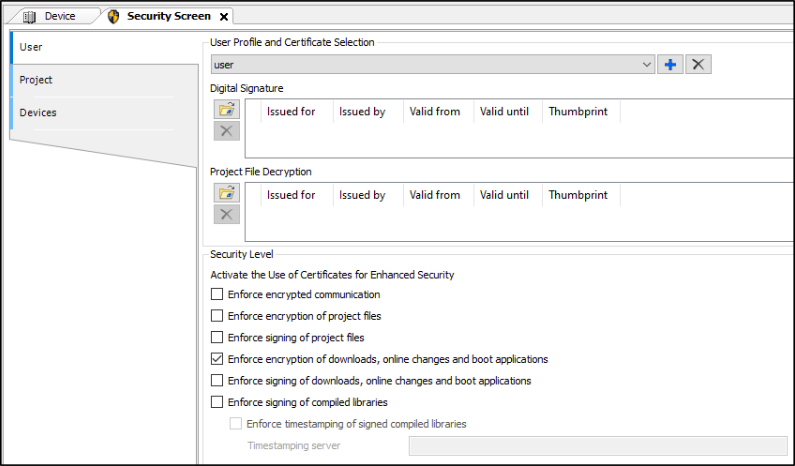
Enforce encryption of Application
The generated certificate for the Encrypted Application can be found in the Security Screen in the Devices tab. As long as the certificate is not generated, a placeholder labeled ‘Encrypted Application (not available)’ is displayed here.

Certificate for Encrypted Application
At this point, the functions are also available to renew the certificate or load it onto the PC (i9x0.CertificateStore.viaPLCDesigner)
In addition, the certificate is also displayed in the Security Screen under project.
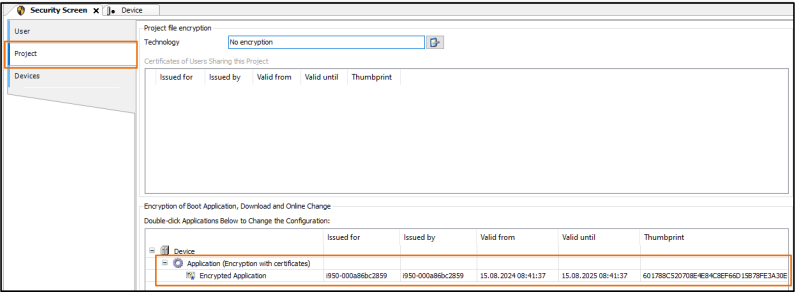
Security Screen Project
After setting up the certificate for the Encrypted Application and Enforce encryption of downloads, online changes and boot applications, the following steps must be completed:
-
Use the »PLC Designer« to build the project again.
-
Write the application to the i9x0.
-
Create the boot application.
-
Restart the i9x0.
-
Please note that the entire application is not encrypted, only the application. app, i.e. the application program. Additional data such as
-
Retain Variables
-
Trace Data
-
EtherCAT Master Configuration Files
-
Parameter Sets of the Devices
-
CAM Data
and much more are not included and are unencrypted at the destination.
-
Use Case: i9x0.Application.Encryption with deleted certificate ‘Encrypted Application’
The behavior of the i9x0 is described below if an Encrypted Application was stored as a boot project and the certificate is then deleted.
Pre-Condition
The i9x0.Encrypted.Application with a certificate is activated, downloaded and a boot application is available on the i9x0. After restarting the i9x0, the boot application is running.
Delete the Own Certificate ‘Encypted Application’ on the i9x0:
The next step is to manually delete the ‘Encrypted Application’ certificate on the i9x0, e.g. via the PLC Designer. After deleting the certificate, the application on the i9x0 is still running.
Behavior of the application after different reset levels:
|
Reset Level |
Behavior |
|---|---|
|
Manually stop the application |
After stopping the application, the application can be started. |
|
Reset Warm |
After "Reset Warm", the application can be started. |
|
Reset Cold |
After "Reset Cold", the application can be started. |
|
Reset Origin |
After "Reset Origin", the application can not be started again. |
|
Boot of the i9x0 |
After ‘Boot of the i9x0´, the application can not be started again. |
If the PLC Designer is still logged in to the i9x0, the certificate for Encrypted Application in the Security ScreenWDevices is shown as deleted, e.g. with the placeholder ‘Encrypted Application (not available)’- Refer to next figure (1.). Under "Security ScreenWProject" the certificate for the Encryption of the Application is still shown, because the application of the i9x0 still needs this certificate-Refer to next figure (2.).
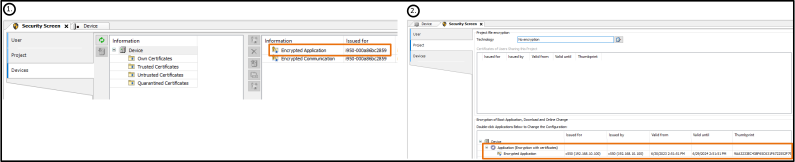
Certificate Encrypted Application Deleted
-
If the Certificate is deleted and the user wants to go online on the i9x0 with the PLC Designer, this is not possible. An online change or creating a boot application is also not possible. The deletion has an immediate effect.
Replace the Own Certificate ‘Encypted Application’ on the i9x0:
After ‘Log Off Current Device User’ and ‘Login’ again, the message ‘The application does not exist’ appears- Refer to next figure (1.).
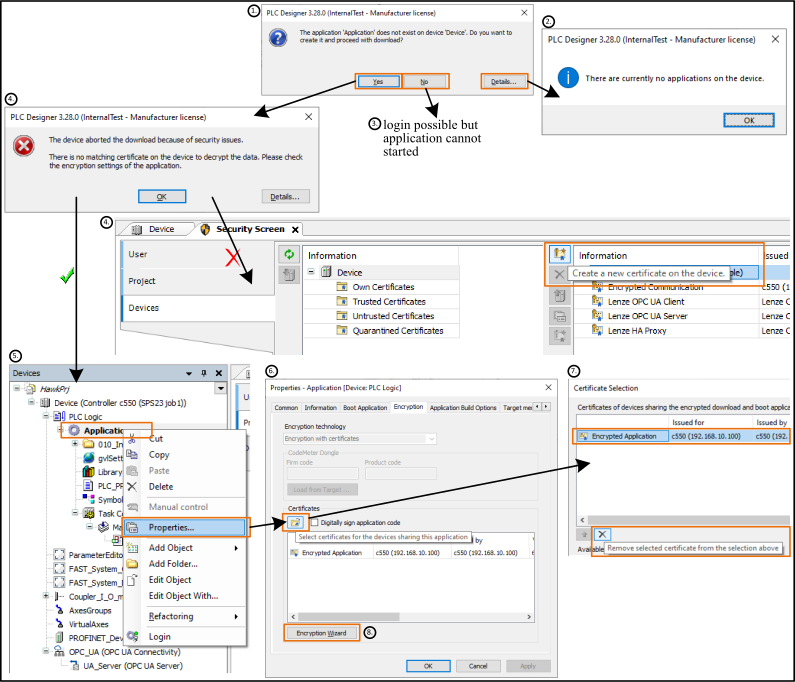
Certificae Encrypted Application Renew
The existing application cannot be downloaded to the i9x0, because there is no matching certificate on the i9x0 available. To solve this problem, please do not generate a new certificate with the Security Screen on the Device for the Encrypted Application, because the certificate will not match the needed certificate for the application.
To solve this problem, open the properties of the application again and delete the existing certificate and generate a new one with the help of the Encryption Wizzard. After these steps, build, download the application Then, generate the boot application and restart the i9x0, The application should be running again.
Use Case: Controller.Application.Encryption with non valid certificate "Encrypted Application"
The behavior of expired Application Encryption Certificate is the same as with a deleted certificate, the application can no longer be started at "Reset Origin" or "Device Boot". The certificate has to be renewed, as previously described.
-
If the certificate has expired and the user wants to go online on the controller with the »PLC Designer«, this is possible. An online change or creating a boot application is also possible. Only after the controller has booted, is it no longer possible to start the application, make an online change or create a boot application.
Use Case: i9x0.Application.Encryption in focus of Device Replacement
The behavior of the i9x0 is described below if an Encrypted Application was stored as a boot project and the i9x0 has to be replaced.
Pre condition
The i9x0.Encrypted.Application with a Certificate is activated and downloaded, and a boot application is available on the i9x0. After restarting the i9x0 the boot application is running.
Replacement of the i9x0:
If the i9x0 has to be replaced due to a defect, the SD card is removed and the i9x0 hardware is replaced. After replacing the i9x0, however, the application does not start. The reason for this is the necessary but missing certificate. An i9x0 exchange is therefore not possible without the previously described certificate renewal process and a new build, download application, creation of a boot project and a restart of i9x0.
Use Case: i9x0.Application.Encryption in focus of Application Loader
-
The offline ‘create boot application’ function from the PLC Designer does not work with the i9x0.Application.Encryption. Therefore, an *.lda cannot be created in this way.
Use Case: Handling one project with i9x0.Application.Encryption for more i9x0
The use case here describes the behavior of a PLC Designer project that is to be used for multiple i9x0. The process is shown in the following figure.
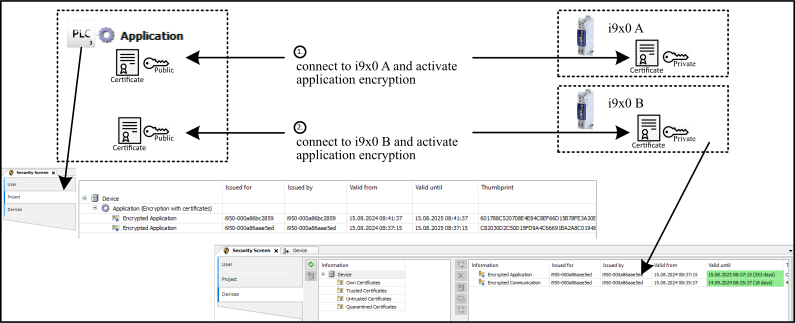
Project for multible i9x0
-
Connect the PLC Designer to i9x0 A and activate the application encryption using the Encryption Wizard of the Application.
-
The i9x0 A will create a certificate including the private key and it will be available in the Certificate Store of i9x0 A as 'Encrypted Application‘ certificate.
-
At the same time, the PLC Project will include the Certificate A including the public key and it will be available in the application for the PLC project.
-
Connect the PLC Designer to i9x0 B and activate the application encryption using the Encryption Wizard of the Application.
-
The i9x0 B will create a certificate including the private key and it will be available in the Certificate Store of i9x0 B as 'Encrypted Application‘ certificate.
-
At the same time, the PLC project will include the certificate B including the public key and it will be available in the application for the PLC project.
-
In the end, the application for the PLC project will include both certificates. Depending on the active application, the corresponding certificate is then used for encryption.