Defining the diameter sensor
At the start of a winding process, it may be required to define a start diameter or use the signal of a diameter sensor to be able to properly start the setpoint generation for the winding drive and also the interference compensation.
The lrLoadDiam input serves to define a start diameter that is accepted with the highest priority and loaded cyclically when xLoadDiam = TRUE.
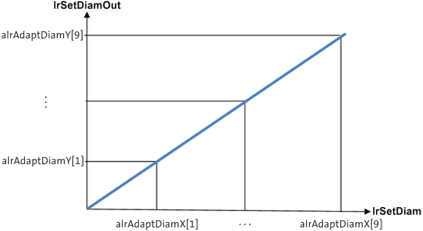
An external diameter value, e.g. of an ultrasonic sensor, can also be connected to the lrSetDiam input. This analog value can be adapted via a curve function Y = f(x). The curve function is set with nine grid points via the parameters alrAdaptDiamX[1...9] and alrAdaptDiamY[1...9]. In order that the analog value is used as start diameter, the adapted curve progression is initialised with alrAdaptDiamY = alrAdaptDiamX. The sensor signal can also be loaded permanently.
In practice, ultrasonic sensors with an analog output variable (0 ... 10 V) are often used for recording a diameter. A curve function Y = f(x) serves to compensate for potential nonlinearities of such a sensor. The function acts on the value which can be diagnosed via the MP_IrSetDiam measuring point. The curve function is set using nine data points via the scPar.alrAdaptDiamX and scPar.alrAdaptDiamY parameters. The value is not adapted when the Lenze setting of the curve function is used. The start diameter is passed through 1:1.
Parameters to be set
|
Identifier Data type |
Description |
|---|---|
|
lrLoadDiam LREAL |
Defining a (start) diameter The diameter is loaded cyclically when the xLoadDiam is set to TRUE.
|
|
alrAdaptDiamX ARRAY [1...9] OF LREAL |
Grid points of the curve function for diameter loading
|
|
alrAdaptDiamY ARRAY [1...9] OF LREAL |
Grid points of the curve function for diameter loading
|
Example: Loading of a diameter via a curve function
-
If the real diameter for loading is not known (no sensor, no operator input possible), a mean diameter should be loaded.