Friction identification
-
If the winder is controlled via an oil-filled gearbox, the friction very much depends on the temperature of the oil. The friction identification should be carried out using gearbox oil that is as warm as possible. For this it is sufficient to previously actuate the motor in a speed-controlled manner for some minutes.
Friction only depends on speed, not on load and diameter. The winder shaft must be empty (no material mounted) when identifying the friction. This allows the maximum speed to be achieved during the identification run movement.
Use the setting lrIdentFricMaxSpdScaled parameter = 1 to define the maximum motor speed (100 %) relating to the maximum winder speed at the lrWndSpdRef output, which may be reached during the identification run. (Usually the motor will also reach the lrWndSpdRef speed with the minimum diameter and at maximum line speed.)
The scPar.lrIdentFricAccDec acceleration for the identification run must be adapted to the current basic conditions. The maximum possible torque must be sufficient to accelerate the mass inertia up to the scPar.lrIdentFricMaxSpdScaled parameter over the ramp.
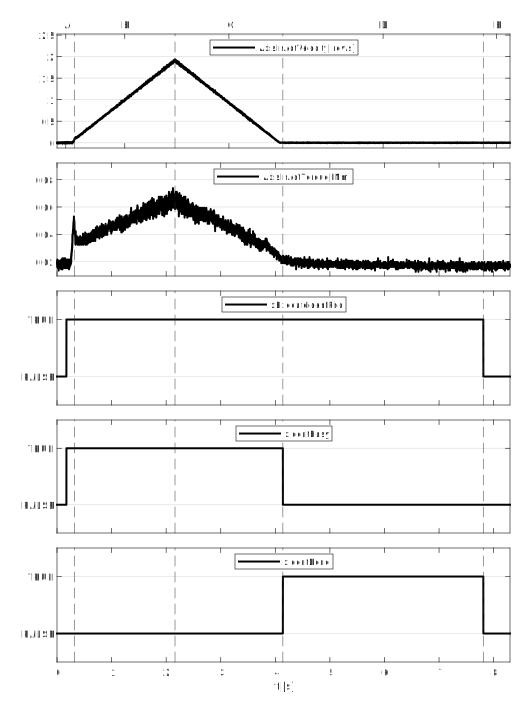
During identification, the drive is accelerated and decelerated using the configured parameters. This movement saves the current torques evenly distributed across an array of 66 elements. The first 1 to 65 elements of the array form a friction characteristic. The reference speed that was reached during identification is set in element 66. The speed-dependent torque must be compensated during subsequent winder operation.
|
No |
xExecuteIdentFric |
xIdentBusy |
xIdentDone |
eTMState |
INFO |
|---|---|---|---|---|---|
|
A |
FALSEäTRUE |
FALSE äTRUE |
FALSE |
STANDBY IDENTFRICTION |
Identification is activated. The winder is moved into speed mode CSV. Torque is built up until the winder begins to move. The torque required for the winder axis to break loose is referred to as Coulomb friction (static friction) and is saved in the friction characteristic. |
|
B |
TRUE |
TRUE |
FALSE |
IDENTFRICTION |
The speed of the winder drive is accelerated over the defined ramp for identifying friction up to the maximum speed set for identifying friction in the parameter setting. The torque identified via the speed is saved as the torque for viscous friction (sliding friction) in the friction characteristic. The maximum speed achieved is the reference speed for the friction characteristic and is saved in the friction characteristic under index 65. |
|
C |
TRUE |
TRUE |
FALSE äTRUE |
IDENTFRICTION |
The speed is decelerated until standstill is achieved. The torque is evaluated using the speed and corrected in the friction characteristic. |
|
D |
TRUEæFALSE |
TRUEæFALSE |
TRUEæFALSE |
IDENTFRICTION STANDBY |
The winder drive comes to a standstill. This completes friction identification. The Done status is set for identification. |
|
E |
FALSE |
FALSE |
TRUEæFALSE |
STANDBY |
If the friction identification request is reset, the Done status is also reset. |
The control stability of the drive and the actual value resolution of speed and torque are directly included in the characteristic. Filtering the current values often improves the continuous progression of the identified characteristic: scPar. rFiltTimeIdentFricSpd, scPar.rFiltTimeIdentFricTrq.
Optionally up to 4 friction characteristics can be recorded and stored. A change-over between different friction characteristics is for instance required when variable speed drives are used.
The friction characteristic is detected with a rising edge (FALSEäTRUE) at the xExecuteIdentFric input.
Termination of the identification
The identification is completed as soon as the motor has reached standstill again, no errors have been reported and xIdentDone has been set to TRUE.
The detected torque setpoints can be checked for plausibility and can be corrected if required.
The friction compensation is activated with xFricCmps = TRUE.
Parameters to be set
See also: L_TW2P_scPar_WinderTensionCtrlState basic functions
|
Identifier Data type |
Description
|
|
|---|---|---|
|
rFiltTimeIdentFricSpd REAL |
PT1 filter time for the winder shaft speed for friction identification
|
|
|
rFiltTimeIdentFricTrq REAL |
PT1 filter time for the winder shaft friction torque for friction identification
|
|
|
lrIdentFricMaxSpdScaled LREAL |
Speed for friction identification
|
|
|
lrIdentFricAccDec LREAL |
Acceleration for friction identification
|
|
|
dwSelectFricCurve DWORD |
For friction identification (input xFricCmps = TRUE): Selection of the memory area in which the friction values identified are stored. A maximum of 4 characteristics can be stored.
|
|
|
For friction compensation (input xExecuteIdentFric = FALSEäTRUE) Selection of the characteristic for friction compensation
|
||