Controller.UserManagement
Controller.UserManagement has been available since FW version 01.07.00.
To implement Controller.UserManagement, the »PLC Designer« offers a user management administration for the c5x0 runtime. Once enabled on the Controller, an anonymous online connection cannot be established with the device. This can be used, for example, to avoid accidentally overwriting a PLC program or transferring it to the wrong controller.
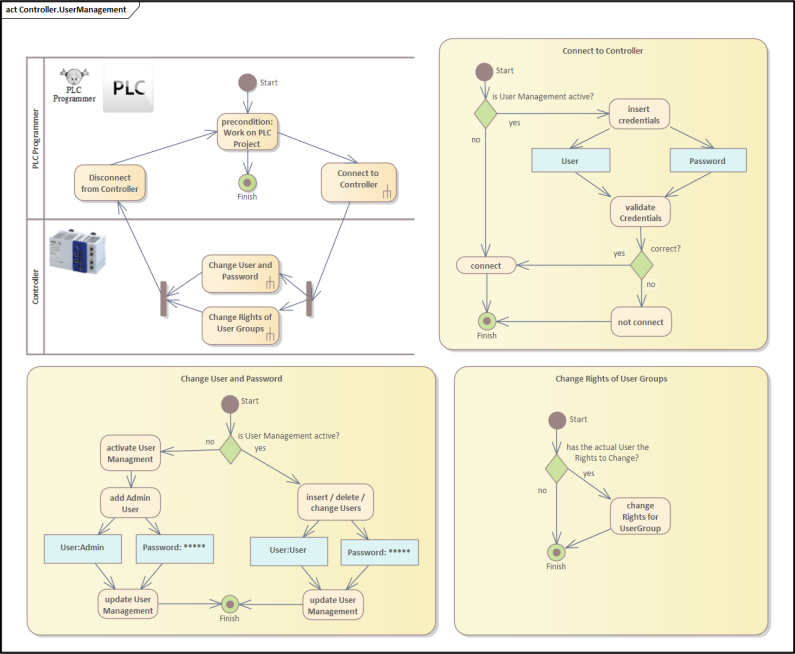
Activity Diagram
Controller.UserManagement: Activating
To activate user management, the »PLC Designer« must be connected online to the controller. Go to settings
Menu / Online / Security / User Login ...
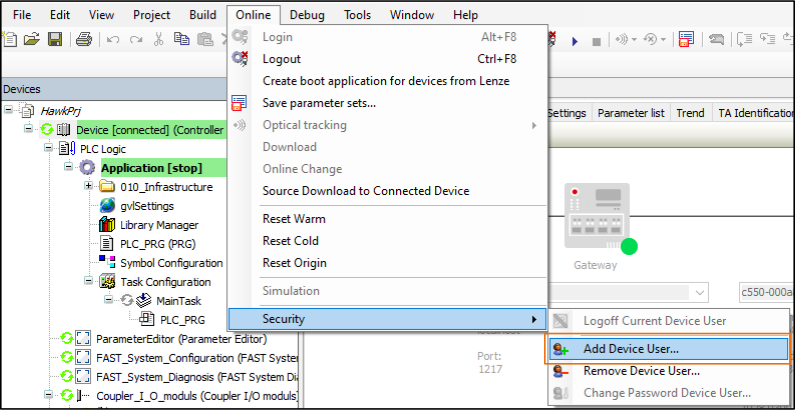
Add Device User
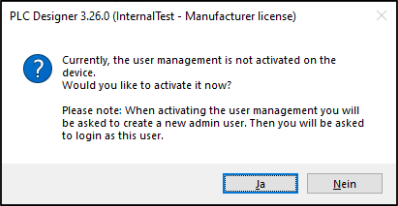
Activate user management
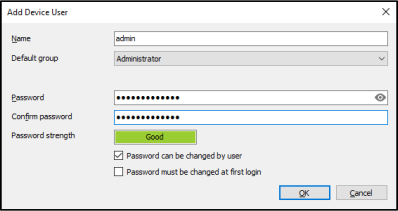
Add Device User Dialog
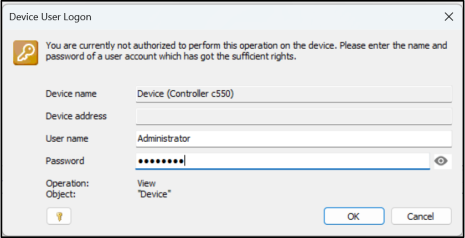
Device User Logon
Controller.UserManagement: Change Users and Groups
To manage the users, first synchronize the user management, with the following:
Device-Tree / Project / double-click on Device / Menu Users and Groups / Synchronization
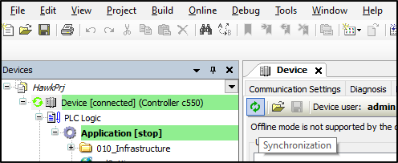
Synchronization
Adding a user is accessed via the Add... option.. Between the roles { Administrator | Developer | Service | Watch }. If additional roles are to be created, they can also be created with Add... or deleted with Delete.
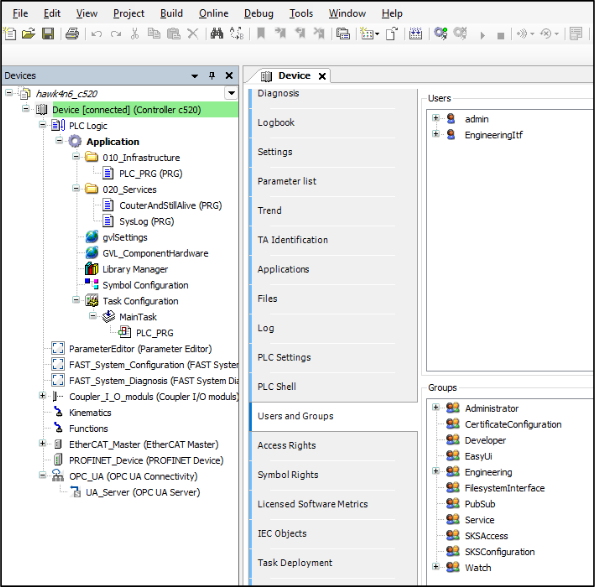
Set Users and Groups
Controller.UserManagement: Groups
-
Administrator:
When you log in to the device for the first time, you will be instructed to activate the device user administration and then create a user in the Administrator group. As this user, you can set up additional users and groups and assign access rights. -
Developer:
Rights for download, online change, debugging, forcing. -
Service:
Backup&restore of the IEC application, update of the IEC application (transfer of boot projects), but no programming/debugging of the IEC application. -
Watch:
Read-only authorisation. -
Engineering:
Group for the access rights of the EASY Starter Suite (consisting of EASY Starter, EASY Firmware Loader and EASY Application Loader). -
EasyUI:
Group for the access rights of the EASY UI Designer. -
FilesystemInterface:
Group for the OPC UA Server File Access. -
PubSub:
Group for dynamically change the OPC UA PubSub configuration. -
CertificateConfiguration:
Group for pushing certificates from GDS or e.g. UA Expert. -
SKSAccess:
Group for the OPC UA SKS Server Access. -
SKSConfiguration:
Group for dynamically change the OPC UA SKS Server configuration.
Controller.UserManagement: Runtime Password Policy
The Runtime Password Policy has been available since controller firmware version 1.13.0 in combination with PLC Designer 4.0.0. The User can activate the Runtime Password Policy, by clicking on the device in Device-Tree / Communication Settings / Device / Change Runtime Password Policy. Now, the settings for the policy of the device, in this case the controller, can be done.
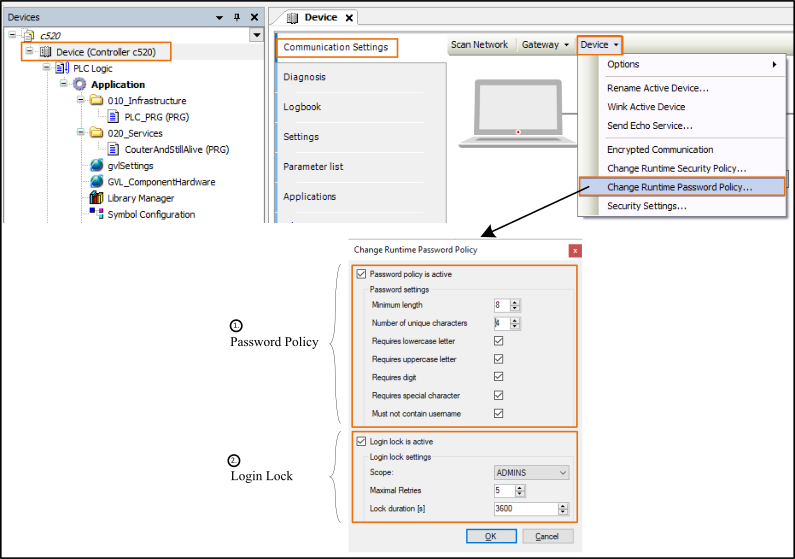
Runtime Password Policy
In the section `Password settings` the user can specify the minimum requirements of the passwords.
-
Minimum length
Minimum length of password characters (all characters count, whether they are letters, numbers, special characters).
-
Number of unique characters
Minimum number of different unique characters.
-
Requires lowercase letter
{ a-z, ä, ö, ü, ß }
-
Requires uppercase letter
{ A-Z, Ä, Ö, Ü }
-
Requires digit
{ 0-9 }
-
Requires special character
{ ^, °, !, “, §, $, %, &, /, (, ), =, ?, `, {, [, ], }, \, ´, +, *, ~, #, ‘, -,_, ., :, ,, ;, <, >, |, @, €, µ }
-
Must not contain username
The username string is not allowed in the password.
-
Activating or changing the password policy settings will take effect immediately. However, the changes only apply to the assignment of new passwords. Existing passwords remain valid, even if they do not comply with the policy.
In the section `Login Lock settings` the user can specify the lock after unsuccessful logins.
-
Scope
ADMINS: The Login Lock settings are valid for all users in the Administrator Group.
NONADMINS: The Login Lock settings are valid for all users except Administrators.
ALL: The Login Lock settings are valid for all users.
-
Maximum Retries
-
Lock duration [s].
Lock duration for this locked users in seconds.
-
If a user attempts to log in unsuccessfully a maximum number of times, their account will be locked. The login options of other users will remain unaffected.
Controller.UserManagement: Password Expiration
The Runtime Password Expiration is available since Controller Firmware Version 1.14.0 in Combination with PLC Designer 4.1.0. The User can activate the Runtime Password Expiration, with Click on Device in Device-Tree / Communication Settings / Device / Change Runtime Password Policy. Now the settings for the Policy of the Device, in this case the Controller, can be done. This function is deactivated by default.
-
Scope:
ADMINS: Password Expiration is valid and active for all admin-Users.
NON-ADMINS: Password Expiration is valid and active for all non-admin-Users.
ALL: Password Expiration is valid and active for all Users. -
Timeout [days]:
1 ... 1000 days for valid password until forced password renewal.
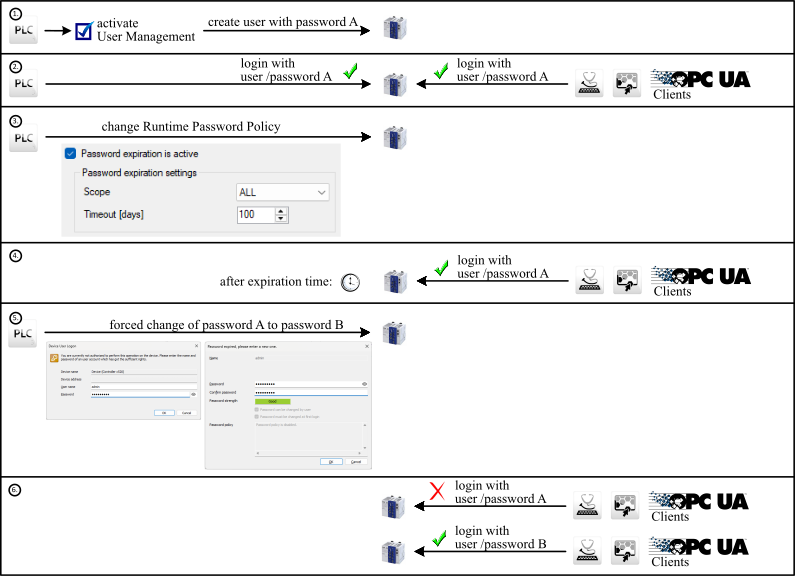
Runtime Password Expiration
The following sequencer describes the mechanism:
-
( 1 ) Firstly, user management must be activated on the device (in this case the controller) by the PLC Designer. A first user with example password A must be assigned.
-
( 2 )The user can then log in with user and his password A using PLC Designer or other communication channels.
-
( 3 ) If desired, the Runtime Password Policy can be activated.
-
( 4 ) After the set time has elapsed, all other communication channels can continue to log in with the known user and password A. These other communication channels can be, for example, the EASY Starter, the EASY Firmware Loader, the EASY Application Loader, the EASY UI Designer or an OPC UA Client.
-
( 5 ) The next time the user attempts to log in using the PLC Designer, they will be prompted to change the password.
-
( 6 ) Once the password has been changed, this password is also valid for the other communication channels.
Controller.UserManagement: Change Access Rights
To manage the access rights, first synchronize the user management with the following:
Device-Tree / Project / double-click on Device / Menu Access Rights / Synchronization
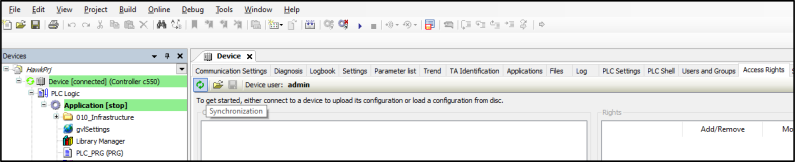
Synchronize Access Rights
To manage the access rights to the objects, the following setting option is available.
Device-Tree / Project / double-click on Device / Menu Access Rights
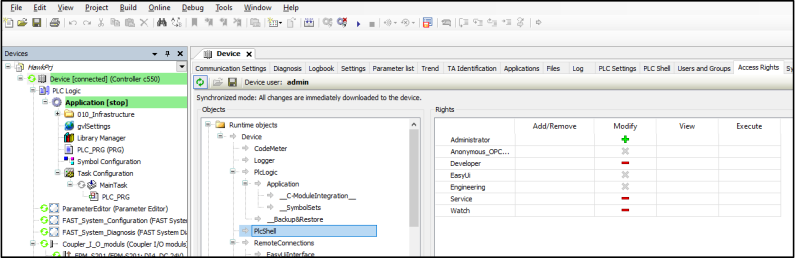
Setting the Access Rights
For each node, the setting of the authorization can be set here.
The Administrator group has a special feature. The settings can be changed in the interface, but the group basically receives all rights.
Controller.UserManagement: Remove
To remove the user management (Attention: All users, groups and access rights will be removed) right-click on the controller device in the device tree of the PLC project and execute the "Reset Orogin Device" for the user management.
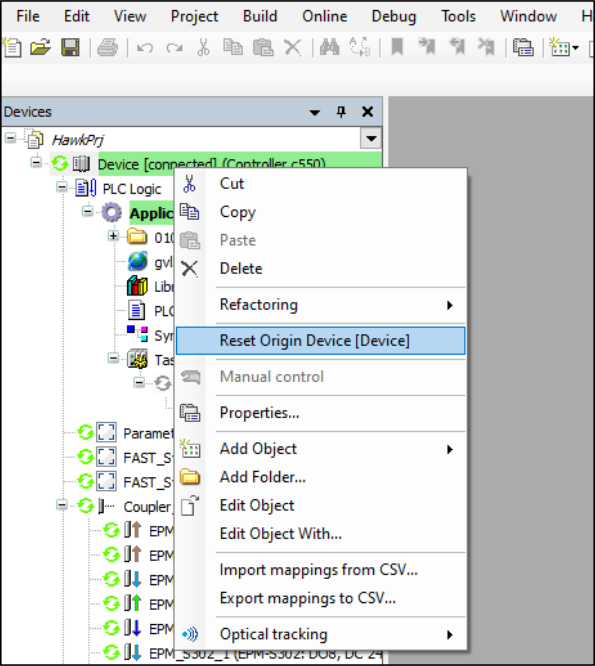
Reset Origin Device [Device]
Controller.UserManagement: EngineeringItf
User management is not activated in the delivery state. Therefore there is no need for other tools (e.g. EASY Starter, Firmware Loader or Application Loader) to authenticate to this controller. If user management is activated (Controller.UserManagement: Activating), these tools must identify and authenticate themselves before they can go online. The activation and settings of the user management are is done with the »PLC Designer«. For this purpose, the user has the possibility to change the necessary settings. A login as administrator is necessary for this. A sequence can be found in the following picture.
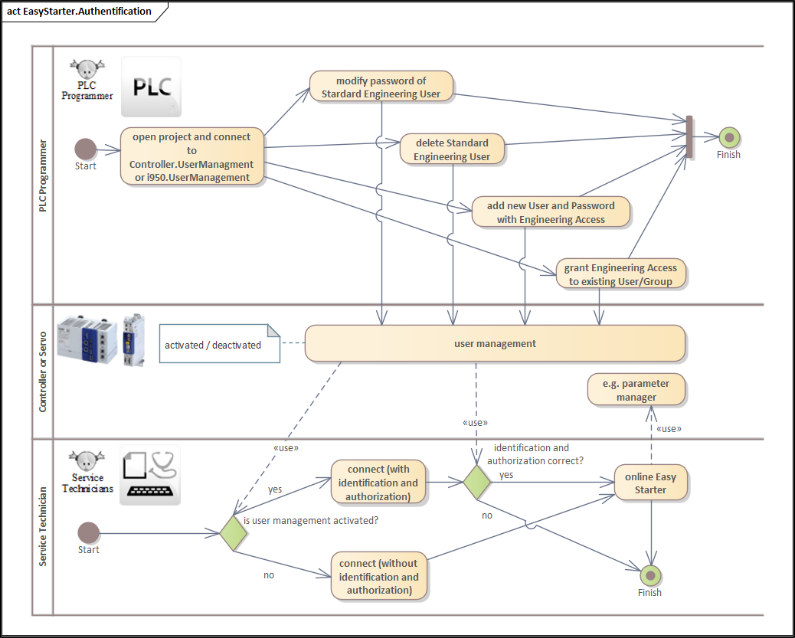
Controller.UserManagement: EngineeringItf
Modify password of Standard Engineering User
When user management is activated, the Engineering group is automatically created with the standard "EngineeringItf" user. A default password is also assigned automatically. It is recommended to change this default password and personalize it. In addition, there is an entry called ''EngineeringInterface'' in the rights management under the group ''RemoteConnections'', where the rights for the above-mentioned user can be set.
Delete Standard Engineering User
If the programmer deletes the user "EngineeringItf", access to the controller from the »EASY Starter Suite« is no longer possible without authentification.
Add new User and Password with Engineering Access
The programmer can add a new or an existing user to the "Engineering" group. This gives every user the opportunity to connect via »EASY Starter Suite«.
Grant Engineering Access to existing User/Group
The programmer can also inherit the rights of the ''Engineering'' group.
Access Rights
In the »PLC Designer«, the "Runtime objects / Device / RemoteConnections / EngineeringInterface" can be set under the "Access Rights" tab. Only the "Modify" rights can be set here. With this setting, the above access can be consented to or not.
Anonymous login
For an anonymous login to the »EASY Starter Suite« the user "EngineeringItf" user is available in the "Engineering" group.
In the settings under "Communication Settings / Device / Change Communiation Policy" there is an option in the "Device User Management" category called, which is "Allow anonymous login". This setting affects the OPC UA server. If anonymous login is prohibited, the user "Anonymous_OPCUAServer" and the group "Anonymous_OPCUAServer" will be deleted in the Controller.UserManagement.
-
Do not add a new user to the 'Anonymous_OPCUAServer' group.
If anonymous login is prohibited, the "Anonymous_OPCUAServer" user and the "Anonymous_OPCUAServer" group will be deleted. This means that the connection to the previously created user is also lost and he is left alone.
Controller.UserManagement: User for »EASY UI Designer«
User management is not activated in the delivery state. In this context, no other tools (such as »EASY UI Designer«, »EASY Starter«, »Firmware Loader« or »Application Loader«) are required to authenticate to this controller. If user management is enabled, these tools must identify and authenticate themselves before they can go online. The activation of the user administration as well as its settings takes place with the »PLC Designer«. For this purpose, the user has the possibility to change the necessary settings. This requires logging in as an administrator. For a sequence, see the following figure.
Use of the »EASY UI Designer« with deactivated user management
If the user management on the controller is deactivated, authentication from the »EASY UI Designer« is not necessary and access can take place without changing the default settings.
Create a user to be able to use the »EASY UI Designer« with activated user management
If user management is activated on the controller, the following steps must be completed:
-
When user management is activated by the »PLC Designer«, an "EasyUI" group is automatically created in the "Users and Groups" menu under "Groups". are no users in this group.
-
By adding a new user to the "EasyUI" group, that user can later authenticate to the controller with the name and password assigned here with the »EASY UI Designer«.
-
Existing users can be also added to the "EasyUI" group. This also gives them permission.
-
Furthermore, entire complete other groups can be added to the "EasyUI" group, thereby granting those groups the same permissions.
Hardening the controller by prohibiting the use of the »EASY UI Designer«
If the »EASY UI Designer« is not required for commissioning, operation and maintenance, the automatically created "EasyUI" group can be deleted. As a result, access is no longer possible with activated user management from the »EASY UI Designer«.
Hardening of the access rights by the created users for the »EASY UI Designer«
After the configuration of the user management described above, the rights for the "EasyUI" group can be restricted. This is done via the "Access Rights" tab. The setting can be found under "Runtime objects / Device / RemoteConnections / EasyUiInterface". With the settings Modify, View and Execute, the rights can be further restricted.
-
All users in the group have the same rights.
Controller.UserManagement: Security functionality verification
Activate the user management as described in the chapter “Controller.UserManagement: Activating”. Connect to the PLC. When the user management opens, type enter correct username and a wrong password. The PLC must deny the connection.
Connect to the PLC. When the user management opens, enter a wrong username and a correct password. The PLC must to deny the connection.