PI controller for the dancer position control
With dancer position control, the drive is actuated in closed-loop speed control. Activating the dancer position control with the xDancerCtrl input = TRUE initiates closed-loop control to an actual dancer position value.
The line speed signal multiplied with the reciprocal value of the diameter serves the purpose of feedforward control. The dancer position is recorded and compared with the setpoint position. If a deviation is detected, the dancer position controller provides for a correction of the speed setpoint.
The dancer controller works according to a typical PI structure. The control is enabled with xDancerCtrl = TRUE. As long as the xDancerCtrl input remains FALSE, the system deviation remains zero and the ramp generator for the dancer position setpoint is loaded with the actual value of the dancer limit position.
With a actual value signal of the dancer of the lrActDancerPosIn input, which is resolved to a limited extent, a PT1 filtering can have a positive impact on the stability of the control loop. On the other hand, dead times in the control loop should be avoided if a high dynamic performance is required. The filter time can be set with the rFiltTimeActDancerPosIn parameter (standard setting: 5 ms).
The correcting variable of the PI controller is led via a limiter, allowing for a limitation via the scPar.lrDancerPosCtrlLimitPos and scPar.lrDancerPosCtrlLimitNeg parameters.
The correcting variable has an additive effect in the main speed setpoint path. The impact via the lrDancerPosInfluenceScaled input acts multiplicatively on the correcting variable of the PI controller. In this way, the impact of the correction value is defined.
The controller gain is set via lrDancerPosCtrlGain . The I component of the PI controller can be set with the lrDancerPosCtrlResetTime parameter (controller reset time). In the standard setting, lrDancerPosCtrlResetTime is set = 0 (deactivated). Without an active I component, there will generally be a deviation from the dancer setpoint position. The I component is therefore normally used and must be set accordingly during commissioning. Typical values are in the range of 200-1000ms.
When the dancer position control has been activated, the dancer must be brought to the setpoint position first. In order to ensure that the dancer is lifted in a controlled fashion, the current actual position value for the position setpoint is loaded to the ramp generator first. The ramp is set via the scPar.lrDancerPosRamp parameter (standard setting: 1 = 100 %/s). This makes it unnecessary to display the impact of the dancer controller. The setting scPar.lrDancerPosRamp = 1 is set as a default in the technology and means that the setpoint is led from 0 to 1 within one second. In the winding mode, any change of the setpoint at the lrSetDancerPosScaled input is led via ramp generator.
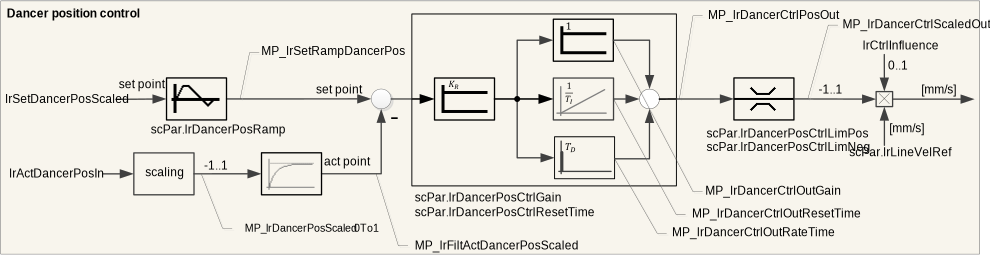
 Signal flow of PI dancer position controller
When the input xResetICtrl = TRUE, the I component of the PI controller is switched off and the correcting variable (output of the controller) from the I component is led via the ramp function to '0'. The correcting variable from the P component is not affected.
Parameters to be set
|
Identifier Data type |
Description |
|
|---|---|---|
|
lrDancerPosRamp LREAL |
Acceleration ramp for dancer position setpoints
|
|
|
lrDancerPosCtrlGain LREAL |
Controller gain
|
|
|
lrDancerPosCtrlResetTime LREAL |
Controller reset time
|
|
 L_TW2P_scPar_WinderDancerCtrlState